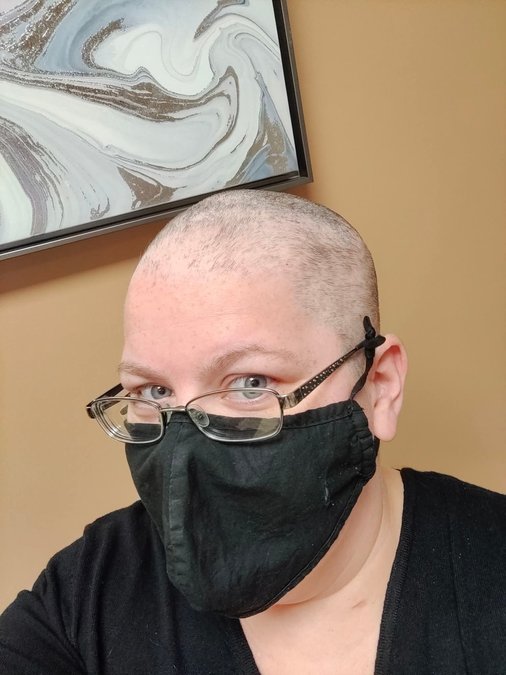
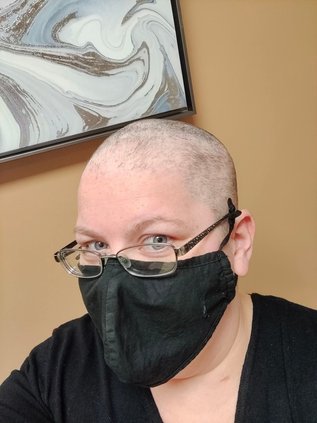
At 39, she faced a breast cancer diagnosis and a future filled with questions. Her doctor didn’t promise there wouldn’t be dark days. Instead, the advice was to give herself permission to visit that darkness — but never make it home, and to hold on to whatever hope and positivity could help her find her way back into the light.
“I always had lumps so I wasn’t concerned when I first found it,” Brandy Selfridge said. “My doctor always told me that if they didn’t go away, then come in.”
This time, it didn’t go away. After discovering the lump in July, 2022, she contacted her doctor in September, only to find they didn’t have an opening until late October.
“I called to tell them I found a lump and my doctor opted to send me straight for a mammogram.” she said. “It came back questionable on both sides so they ordered a biopsy.”
Because this one felt different, Selfridge’s husband accompanied her to the appointment. Her phone rang on Nov. 7 with the results. The deep lump Selfridge felt on the left side was benign. However, they found stage 2 triple-negative breast cancer on the right.
“I was home alone with my kids so I took the call outside in my car,” she said. “Thinking back, they probably knew something was wrong.”
After calling her husband, who was working out of state, Selfridge called her best friend.
“One of them called my mother-in-law and asked her to call my teenage daughter and have her take the other kids over to her house,” she said. “They stayed there until my husband got home and my best friend stayed with me.”
Her children were 16, 13 and 7 at the time. Selfridge said her greatest fear was that she wouldn’t see them grow up.
“My doctor said this is a scary time with a lot of unknowns but don’t live in the darkness,” she said. “The doctor said the darkness will come up and you will have dark times hit you but you can’t stay there. You can visit but make sure you use whatever positivity you can gain out of this experience and bring yourself out of the darkness.”
Selfridge and her husband sat the children down and gave them the news together.
“We told them we weren’t going to keep anything from them; whatever happened, they were going to know,” she said. “I didn’t want them to have any uncertainty.”
Not wanting her children to watch her suffer through all the stereotypical stages of treatment, Selfridge told them she did not want chemotherapy or radiation.
“But when they cried, I realized I was more open to different treatments than I thought,” she said. “I made a goal of walking all of my kids down the aisle.”
Selfridge took her children to her appointment to discuss her treatment plan. Triple-negative breast cancer an invasive breast cancer type where the cancer cells test negative for estrogen receptors, progesterone receptors, and HER2 protein overexpression.
It accounts for about 10% to 15% of all breast cancer diagnoses and is more commonly diagnosed in younger women (under 40), premenopausal women, Black and Hispanic women, and individuals with an inherited BRCA1 gene mutation. This type of breast cancer tends to grow and spread faster and has a higher risk of local recurrence compared to hormone-receptor-positive or HER2-positive breast cancers.
“I did the BRCA gene test and there was no mutation,” Selfridge said. The doctor emphasized my kids should get tested at 25 but at least they’re not going to go into an unknown now. “
Her treatment plan was chemotherapy once a week for 12 weeks and then either a lumpectomy or mastectomy. Selfridge opted for a double mastectomy.
“My doctor thought she could get it with a lumpectomy but I’m a very anxiety-driven person so, for me, that wasn’t an option,” she said. The most difficult part was losing something that was a part of my body. It’s a nonvital part but losing it makes you feel less of a woman.”
Selfridge feels she was given this journey for a very specific reason.
“My mother was diagnosed the next year and God knew my parents needed to see there was a light at the end of the tunnel,” she said.
Her mom’s cancer was triple-positive breast cancer but because of Selfridge’s experience, she found the lump while it was less than one centimeter and stage 0. During her own journey, Selfridge chose to isolate her parents as much as she could.
“I didn’t want my dad to have that image in his head of his little girl going through all of this,” she said. “The one time I allowed my mom to take me for treatments, I had a reaction so everything I was trying to shield her from, she took the worst brunt of.”
Selfridge’s husband took a job that allowed him to stay closer to home but her best friend accompanied her to every appointment.
“She was my biggest source of strength throughout my journey,” she said.
Losing her hair was one of the hardest parts for Selfridge, along with the anxiety and fear she sees in her children.
“My kids are very anxious and scared about my health,” she said. “It makes them so anxious every time I get a scan, while I don’t keep it from them, I don’t always indulge them when it happens.”
Selfridge still has lab work done every six months but not for much longer.
“I’m at the point where I have one more year before I can say I’m cured,” she said. “With triple-negative, the chance of recurrence drops at that five-year mark.”
At the first of the year, Selfridge was feeling some shortness of breath so a PET scan, an MRI of her brain and a CT scan of her chest and abdomen were ordered. All came back normal.
“After my diagnosis, I decided I wasn’t going to wait for anything,” she said. “If I want something or want to do something, I was going to do it.”
Selfridge has two nodules in her lung that have been monitored since she was diagnosed. While they’ve grown, it’s not currently enough to cause concern or order a biopsy.
“I learned I’m stronger than I look and I don’t mean that in a negative way,” she said. “It’s just no matter what is given to me, I can overcome it.”
The advice her doctor initially gave her is the advice she would pass on to other women recently diagnosed.
“Don’t stay in the darkness. look for the positives. Think of what you gain out of it because you gain a support system – you always have it but you just don’t realize how much support you have until you need it,” Selfridge said. “Everyone is stronger than the storm.”