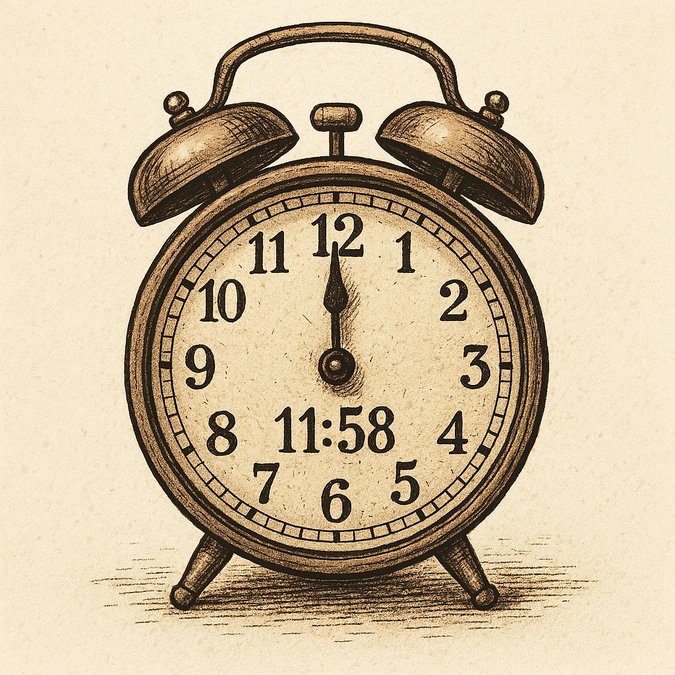
It is now 85 seconds to Midnight, the Bulletin of the Atomic Scientists announced on Jan. 27.
That is the closest it has ever been in the history of this symbolic portrayal of the state of the world. Since 1947, the Doomsday Clock has metaphorically represented the risk that we will succumb to human-made threats, with midnight representing Armageddon. Now, its creators say, we are closer to that than at any time in the last 80 years.
Founded in 1945 by Albert Einstein, J. Robert Oppenheimer, and University of Chicago scientists who helped develop the first atomic weapons in the Manhattan Project, the Bulletin of the Atomic Scientists created the Doomsday Clock two years later. The Doomsday Clock was originally used to count down the symbolic minutes we were from global destruction caused by nuclear war – midnight on the clock’s countdown to zero.
The status of the countdown is revised every year, and the existential threats it proclaims have also changed. Once, we were told the hands on the clock could stay the same or move ahead, but could never be turned back.
Somewhere along the line, the world became a safer place. The hands on the clock COULD be pushed back. The threat of annihilation by global nuclear war receded.
Enter climate change. Today, the Clock has become a self-proclaimed indicator of the world’s vulnerability to global catastrophe caused by man-made technologies. Along with the risk of nuclear war, the scientists cite dangerous trends at every turn, including pandemics (and biosecurity threats) and the AI revolution.
Countdown to ... what? When the Clock was set in 1947, the Bulletin announced, “It is seven minutes to midnight.” The minutes slipped away. In 1949 it was 3 minutes to midnight and in 1953 it was 2 minutes to midnight, after the United States decided to pursue the hydrogen bomb, a weapon at least 1,000 times more powerful than the atomic bombs dropped on Hiroshima and Nagasaki.
Then, lo and behold, the hands of the clock did move back, in 1960 and again in 1963, after serious peace talks between the United States and the Soviet Union. We did not return to 2 minutes to midnight until 2018 and again in 2019. After that, we shifted from minutes to seconds.
Part of me believes the Doomsday clock is an old cliche that needs to be retired. It is about as timely as the book, “88 Reasons Why the Rapture will be in 1988,” or Al Gore’s prediction in “An Inconvenient Truth” that there would be no more measurable snow cover on Kilimanjaro in Tanzania by 2016. Gore also predicted in 1997 that the glaciers in Glacier National Park in Montana would be melted by 2020.
The truth about glaciers is more complex. The U.S. Geological Survey had indeed made forecasts warning the end of the glaciers in Montana by 2020. They are still there.
None of this is to say that humankind doesn’t face real challenges that we cannot afford to ignore. On the topic of climate change, NASA has reported, “There is unequivocal evidence that Earth is warming at an unprecedented rate. Human activity is the principal cause.” (science.nasa.gov/climate-change/evidence). If an illustration of a Doomsday Clock prompts people to take action, so much the better. I’d prefer something less alarming – like a Doomsday Alarm Clock with a snooze button, but I suppose there’s no point in sleeping through Armageddon.
One alternative that has been suggested is the Peace Clock, launched in 2025 by an activist group called CodePink (codepink.org). This group wants to move away from predictions of doom and instead promote active steps for a “livable world.”
We may not agree on the issues or the solutions, but each of us can choose to stay informed and consider ways to help make the world a better place – with or without that ticking clock.
Susan Thacker is the editor of the Great Bend Tribune. Email sthacker@gbtribune.com.