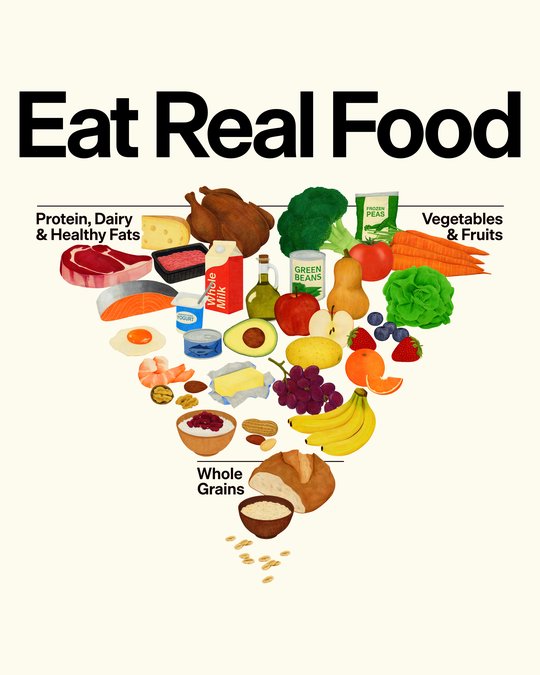
“Better health begins on your plate—not in your medicine cabinet. The new Dietary Guidelines for Americans defines real food as whole, nutrient-dense, and naturally occurring, placing them back at the center of our diets.” – RealFood.gov.
Brilliant! Eat better to live longer and healthier. The new federal dietary guidelines have turned the old food pyramid upside-down – Literally.
The Dietary Guidelines for Americans are updated every five years. For decades, we were given a guide to daily food choice in the form of a pyramid. The tip was for fats, oil and sweets; use these sparingly! As we progressed from the tip to the base, the pyramid tiers grew wider – 2-3 daily servings of milk, yogurt and cheese, and 203 servings of meat, poultry, fish, dry beans, eggs and nuts. The next tier showed 3-5 servings of veggies and 2-4 servings of fruit. The base was 6-11 servings of bread, cereal, rice and pasta.
Later, the pyramid was replaced with the “Make a Healthy Plate” model. A plate almost equally divided by fruits and vegetables making up one half, grains and protein making up the other half, and some dairy on the side.
Were we following those guidelines? The federal website notes 75% of adults in America report having at least one chronic condition, 50% have prediabetes or diabetes, and 90% of U.S. healthcare spending goes to treating chronic disease – much of which is linked to diet and lifestyle.
You can drill down on nutritional science to your heart’s content. Check out The Scientific Foundation for the Dietary Guidelines for Americans, 2025-2030, or the Dietary Guidelines for Americans, 2020-2025 from the USDA.
The federal websites say the new guidelines are being praised for getting it right, putting a bigger emphasis on eating more protein and dairy. Whole grains, which were at the base of the old pyramid, are still at the bottom – but with the pyramid inverted, that means they are now less important.
The guidelines have their champions and their critics but they are worth considering. They will shape what kids are served in school lunches and may have an impact elsewhere. You might say they are food for thought.
Susan Thacker is editor of the Great Bend Tribune. Send email to sthacker@gbtribune.com.