I have spent much of my working life standing beneath trees.
I have studied their trunks, examined their roots, followed their branches into the canopy, and tried to understand what they were experiencing long before the signs became obvious to everyone else.
But on this particular day, as I stood beneath an oak that was nearly one hundred years old, I was not only looking at a damaged tree.
In many ways, I was looking at myself.
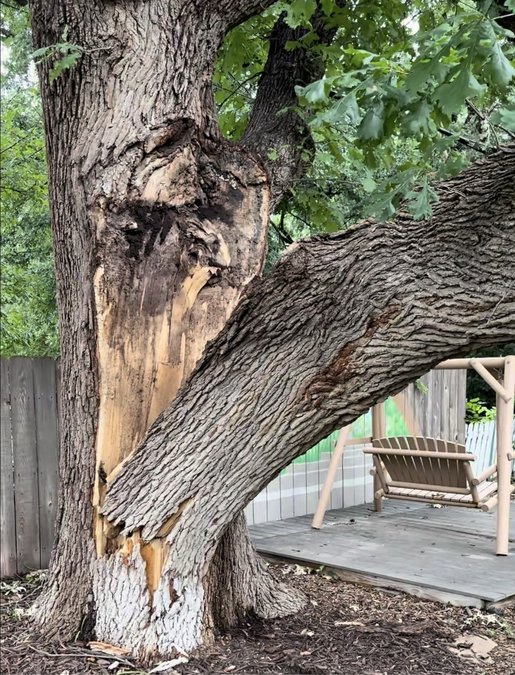
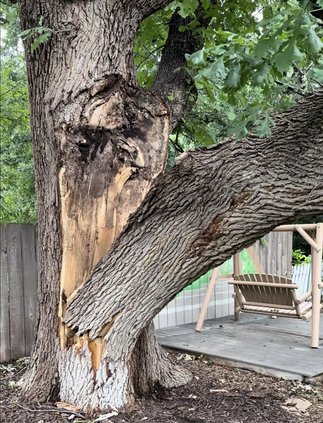
The oak had stood quietly in my client’s back lawn for generations. Its branches stretched across the yard like open arms, likely shading birthday parties, family gatherings, and children who eventually grew old enough to bring children of their own. A beautiful swing sheltered beneath the dense shade of its large limbs.
Then the storm came.
By morning, an enormous portion of the oak was lying across the lawn. One of its largest leaders had split away from the trunk, leaving behind a wound so deep that a person could nearly stand inside of it.
I walked slowly around the tree, studying the failure point, the remaining canopy, and the massive limb resting on the ground. The damage looked sudden.
But I knew it was not.
Storm damage often appears to happen in a single moment, but failure typically begins long before the storm arrives. Weight continues to gradually increase. Structural weaknesses slowly develop. The tree continues carrying more than it was designed to support until one final pressure becomes more than it can bear.
Had some of the weight been reduced from that leader years earlier, the wind might not have placed so much force against it. The storm was not the only reason the tree failed. The storm was simply the final pressure placed upon something that had already been carrying too much for far too long.
As an arborist, I understood what had happened to the oak.
As a man, however, I felt it.
The past couple of months had taken more from me than I knew how to explain. My brother was suddenly gone. The business I had spent years building had begun to feel heavier than the lives it was supposed to support.
I had missed dinners, family gatherings, and phone conversations. I had sat beside my wife more times than I would like to admit while my mind remained somewhere else. I had carried responsibilities, expectations, worries, and grief without ever stopping long enough to decide what could be reduced.
I kept telling myself that once everything settled down, I would return to the man I had been before.
But standing beneath that broken oak, I began to understand something I had often explained to others but had never fully applied to myself.
The tree could survive. But it would never look the way it did before. That did not mean it would always be damaged. It just meant it would be different.
Above the enormous wound, healthy green leaves still filled much of the remaining canopy. The old swing was still hanging beneath it. Strong branches remained, and new growth could eventually develop in places where sunlight had never reached before.
The storm had indeed taken something significant. But it had not taken everything.
No, not every loss in life can be prevented. And some storms will arrive without warning and take things that no amount of preparation could have ever protected.
Even still though, I began to wonder how much of my own life had grown unnecessarily heavy simply because I had never made the decision to reduce what I was carrying.
The oak would require additional care. Some branches would need to be reduced. Others would have to become stronger because they would now carry greater responsibility. The wound may slowly begin closing around the edges, though the scar would likely remain visible for the rest of the tree’s life.
The tree would have to grow into a new shape. But a new shape does not mean a lesser one.
I placed my hand against the bark of the wounded tree.
For months, I had believed healing meant getting everything back to how it was before. The relationships. The certainty. The energy. The version of myself who once believed he was capable of carrying anything.
But as my hand rested against the deep grooves of the bark, I began to understand that restoration does not always mean returning to who we once were.
Perhaps restoration means allowing God to grow something new around the places that have been broken.
Perhaps it also means having the courage to finally reduce the weight we were never meant to carry alone.
Thankfully, the decision was made to keep the tree instead of giving up hope.
In the years ahead, additional care will be given to the oak. The wound may slowly begin closing around the edges. The tree will never become perfectly balanced again, but its remaining branches can strengthen. New growth may reach toward the open sky. The trees surrounding it may eventually help fill portions of the emptiness left behind.
The canopy had become smaller, yet I could not help believing that the shade remaining beneath it might now feel even more precious to the family who had gathered beneath it for generations.
I may never sit beneath that tree. It is not my tree, and its history does not belong to me.
But the lesson it gave me does.
As I imagined the years ahead for that oak, my thoughts eventually turned toward the trees surrounding my own home. I pictured an evening beneath our big ash tree with my wife.
The business would most likely still be demanding. Some things would never return to what they had been before. There would still be questions without answers and people whose absence would always be felt.
But perhaps my phone would be inside the house. Perhaps her head would rest peacefully against my shoulder. Our hands would be joined while the evening breeze gently rustled through the leaves above us.
Perhaps I would finally be there completely. Not thinking about what needed to be done next. Not carrying every problem as though it belonged to me alone. Not waiting for life to return to what it had been before, but allowing myself to be present within the life that still remained.
Standing beneath that client’s damaged oak helped me recognize something I had been unable to see clearly within myself.
The scar along its trunk was not only evidence of what the storm had destroyed. It was evidence that the tree had survived.
I know now, restoration does not mean returning to the person you were before.
Sometimes restoration means becoming someone who has lost deeply, loved more carefully, carried less needlessly, and finally learned that a scar is not proof that life has been ruined.
Sometimes a scar is the exact proof we need to realize that life continues.
We cannot become so focused on what has broken that we fail to recognize what God is still preserving, what remains alive, and what He may already be building next.
“Well Rooted” is a new column to the Great Bend Tribune written by Jeremy Elliott. Elliott owns a lawncare business and lives in the Great Bend area.