For Kelsey Sciacca, relationships aren’t just part of the job — they’re at the heart of it.
The Great Bend native serves as principal of Park Elementary and also oversees Washington Education Center, home to special education services and the district’s RISE program — Relationships, Instruction, Safety and Emotional Well-Being.
It’s fitting that “relationships” comes first.
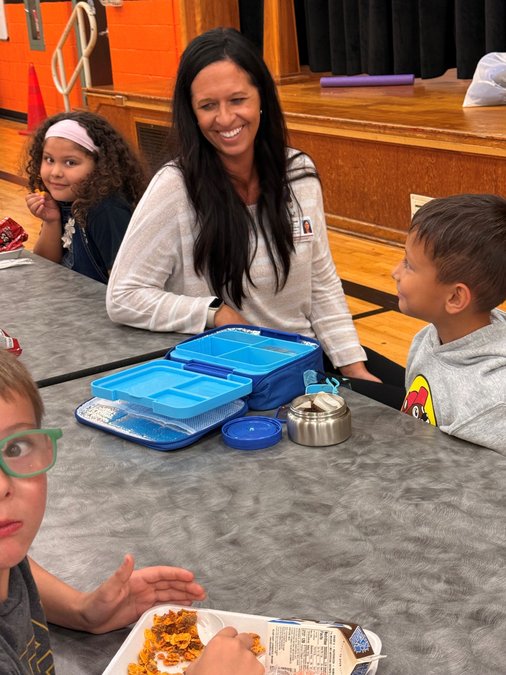
At Park, Sciacca has made connecting with students and their families a priority, believing that knowing the people behind the names — and making sure they know they are valued — is an important part of building a successful school community.
And for Sciacca, those relationships are being built in the community that helped shape her.
“I originally wanted to coach athletics,” the former Barton Community College basketball player said. “I was first hired as an assistant basketball and softball coach, and as head volleyball coach at Great Bend High School. That was my passion.”
However, Sciacca quickly discovered another passion: Park Elementary School.
“I’ve been in this building for 22 years, teaching first and then fourth grade, and then serving as an Instructional Coach,” she said. “I knew I wanted something in administration, but I didn’t know what it would be. I just knew I wanted the opportunity to stay in this building.”
After attending Barton, Sciacca graduated from Fort Hays State University before finishing with her master’s degree in administration from Emporia State University.
Her husband, Adam, is the manager at P&S Electric. Together they have two sons.
“Most of my students don’t know I was an athlete, so it surprises the kids when I’ll play basketball or something with them outside,” Sciacca said.
She said most people also don’t know she’s from Great Bend.
“They feel like I don’t know the background or history of Park when, really, I do,” Sciacca said.
She and her staff set expectations for both students and families at Park.
“It’s been a big shift in the last couple of years,” she said. “We expect students to meet challenges rather than being identified by challenges.”
Sciacca said Park Elementary students come from varying socioeconomic statuses. Park has a large English as a Second Language population, but while the students come from all backgrounds, she said they blend well together.
“We have a lot of transient students,” she said. “Anywhere from 20 to 35 students are in and out of our building in a year.”
Family buy-in and support are paramount to students’ success, Sciacca said.
“We spend a lot of time on relationships with our families and community because if parents stand by staff, that’s a big thing for students to see,” she said.
One thing Sciacca wishes she had known about being a principal is that the things you think will get accomplished rarely do.
“You are managing people all day long – whether it’s staff, students, or parents,” she said. “Everything you have planned for the day, never gets done.”
Sciacca said she tries to get her staff to focus on the positive things that can be controlled.
“We can only control what we can control, but that’s a hard mindset to get through to everyone,” she said. “We know every kid can be successful, but we also know it can be a challenge.”
The Diamond Dogs group serves as a morale booster for the building, giving staff an opportunity to check in on each other.
“We understand we have lives outside of this building and we aren’t defined by what goes on in this building,” Sciacca said. “When you leave, you leave.”
She encourages teachers not to email parents after 4:30 p.m. She said that’s been huge for her staff in dealing with stress and burnout.
Sciacca said years ago, you taught your grade and rarely interacted with other students. With Park Families, every staff member has a “family” of 6 to 12 students, ages kindergarten through sixth grade. The groups meet for 30 minutes twice a week.
“It gives us an opportunity to love every kid in the building and to work on social skills while doing a fun activity,” she said. “It’s been a huge success; the kids absolutely love it.”
Sciacca said her students love school, and for a lot of them, it’s their safe place.
“Holidays can be hard for them to be gone and we worry about them,” she said.
Technology and the expectations for its use are things Sciacca said students struggle with, especially in the summer.
“The transition from being at home and being at school is hard on them,” she said. “We are getting back to handwriting because kids don’t even know how to write in cursive anymore. We’re taking time to get back to the fundamentals of education. Technology is wonderful but there’s a time and a place for it and that kind of got out of control just within society. We’re pulling back on that and that’s been a challenge for kids to understand.”
Park utilizes a Student Improvement Team (SIT) to address any issues.
“If teachers are seeing consistencies in concerns with children, they put them on the SIT team,” Sciacca said. “We meet every couple of weeks and collect data. It can be about academics, behavior, anything. But we try to get on top of it quickly.”
She said while you hear a lot about behaviors in school, and those behaviors are vastly different from when she began teaching more than 20 years ago, it takes time for kids to unlearn behaviors. That’s where the RISE program comes in.
“It’s an alternative out-of-school suspension program and the community has been very supportive,” she said. “All of the schools in the district can use it.”
RISE stands for relationships, instruction, safety, and emotional well-being and is a four-week program for students displaying behavior issues at school.
“It’s intensive and deals with social and emotional skills and how to handle themselves in a classroom,” Sciacca, who is in her third year as Administrator at the Washington Education Center, said. “Then we slowly transition them back into their home building. We’ve had great success.”
She said 35 students have been through the program in the past three years, with 90% transitioning back into their buildings successfully. The program is optional with parents given the choice of suspension instead.
“Staff stays onboard with those students to support them whenever they go back,” she said. “We’ve had good success and I’m very proud of it.”
Sciacca said the idea is spreading more statewide and they’ve done several presentations and training for other districts.
“Data shows that kids who are suspended in elementary school have a higher dropout rate,” she said. “We want to get on top of it when they’re young and make sure they’re successful.”
Sciacca said today’s students are all capable.
“We make a lot of excuses for behaviors and academic needs but they all can do it,” she said. “It’s at different levels, but if we push them and we support them, they can all find success and achievement in the classroom.”
Park is home to 263 students, 46 staff members and 19 teachers.
“I hope the kids remember their relationships with other students and their job as role models, especially in families and interactions with students of all ages,” Sciacca said. “That’s a great skill to have.”