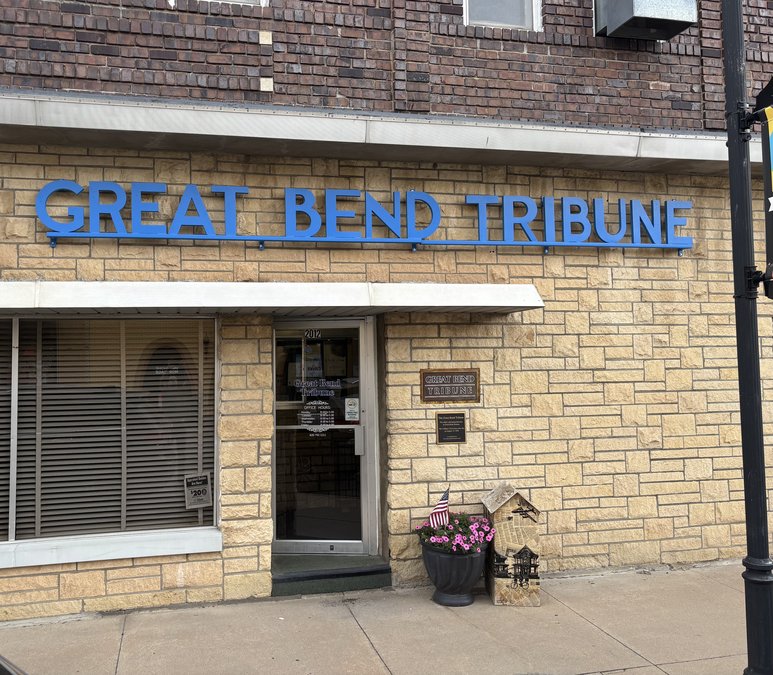
Stop by the Tribune for conversation
A quick update regarding the cup of coffee and conversation I mentioned in my opinion column on Saturday, May 9: I overlooked the fact that the Great Bend Chamber of Commerce hosts their weekly coffee at the same time I originally suggested (9–11 a.m. Thursdays). That was entirely my oversight, and I apologize for any confusion. Chamber events are a wonderful community tradition and the Tribune encourages anyone interested to attend. But my point in extending this invitation is simple — The Tribune exists to tell the story of this community, and the best stories come from you. We’d like to invite you to stop by the office for an informal conversation. No agenda, no program, no pressure — just an open door and a chance to talk about what’s on your mind. What’s happening in your neighborhood? What does this community need? What stories aren’t being told?
We have a dedicated time set aside — Thursdays from 10:30 to 11:30 a.m. — but you don’t have to wait. Our door is open during business hours, and you’re welcome to stop in anytime.
This is your community. This is your paper. Come talk with us.
When I published “Opinions are like Apples” last Saturday, I expected pushback. What I didn’t expect was that the pushback itself would so perfectly illustrate what the column laid out.
For those who missed it: I introduced the 4-D’s of suppressing accountability — deflect, deny, defend, and diffuse. I explained that criticism and demanding accountability are not the same as negativity (deflect), that legitimate concerns are denied validity by reframing them as mere impatience or negativity (deny), that residents who raise those concerns are met with defensiveness rather than answers (defend), and that social pressure is used to silence dissent (diffuse).
The pushback came in two forms. Dale Hogg, a former managing editor of this paper, submitted a letter to the editor which published Thursday. Others contacted the Tribune more directly — in person and by phone. These responses are worth noting — because in their own way, they proved the point.
Let me start with Dale Hogg’s letter to the editor.
Dale and I go way back — he was my managing editor during my early days at this paper. That history is why I hold his letter to the same standard he applied to my column.
Hogg opened by invoking 40 years of journalistic ethics before engaging a single substantive point — then spent the remainder of his letter characterizing my column as a “tirade,” defending the Chamber and its CEO, denying that any such cultural dynamic exists — that dissent is silenced, that accountability is deflected, that the “stay positive” message serves institutions more than community — and warning that the Tribune risks alienating the community it serves.
Deflect. Defend. Deny. Diffuse. One letter. All four D’s.
He is also an active Chamber Ambassador who has written public relations pieces for the Chamber — although neither detail accompanied his letter. When I contacted him for comment, he confirmed his ambassadorship. He later posted his letter to social media and included his Chamber Ambassador role — a detail absent from the letter itself.
Since Hogg chose to question ethics, it bears asking about a moment I had avoided mentioning in my first column — captured on a publicly available Facebook Live video from the Chamber’s Cinco de Mayo booth on May 2. At approximately the 2:37 mark, Hogg made a comment that prompted an immediate visible reaction from those around him — including Chamber CEO Megan Barfield, who intervened quickly. I asked Hogg and Barfield for context or clarification.
Hogg’s response: “I have no idea what was said in the remark you reference since I didn’t hear myself at all during that live feed. Any experienced journalist with an ounce of ethics would understand that an off-the-cuff comment made at that booth is not germain (sic) — we could have been discussing the weather.”
One response. All four D’s. But I do think that moment is germane. An organization urging residents to police their speech while a moment captured on their own camera raises questions — that’s a relevant contradiction. Hogg’s response doesn’t explain the visible and audible reaction of those around him. Rather than address the moment, Hogg deflected to a lecture about journalistic ethics and my credentials for asking.
Hogg’s response then pivoted to his volunteer work. Genuine and admirable. But entirely beside the point. I asked about a specific moment on a video.
He also mentioned in his letter that the local paper is supposed to be a cheerleader — and he is right. But he reminded me several times when I was under his tutelage that one of the roles of the local newspaper is the watchdog. I’m not a lapdog.
Others affiliated with the Chamber who contacted the Tribune expressed disappointment and urged a more positive approach — cautioning about community perception, business relationships, and the Tribune’s standing. Familiar territory. Social pressure.
Chamber CEO Megan Barfield responded to my request for comment regarding the video. She — and others within the Chamber — have characterized my editorial as a response to a post made on her personal social media page. That framing deserves a brief clarification. Community leaders are not private individuals — that responsibility doesn’t pause for a social media post, especially ones directed at the community you serve. The Cinco de Mayo video itself was posted to the Chamber’s official Facebook page before being shared to her personal page. That detail illustrates where that line actually sits.
On the video, Barfield stated: “The event itself was lively and fast-paced, and any brief moment captured reflected the lighthearted, spontaneous nature of the day.”
In closing she wrote: “We are all human and in that should come grace and assuming the best in intentions. We all stumble, and we won’t always get it right, but we have to keep trying and caring. I do believe you and I both care about this community.”
She is right about that — I know both are true. And it is precisely because I care about it that I keep asking the questions.
It is also worth noting the sequence of events. Before Barfield responded to our request for comment, a member of the Chamber’s board had already informed Tribune staff that the video’s audio had been professionally analyzed. Those findings were not shared with the Tribune, nor were they referenced in any response to our request for comment.
Let me be clear about something personal. I do not view this community negatively. I was raised here. I have chosen to raise my family here. I want Great Bend to thrive as much as anyone starting or operating a business or manning a booth at Cinco de Mayo — I was there — my children could have heard those comments “about the weather” as they raided the booth for toys and swag. What I reject is the premise that questioning is the same as negativity. Those questions are not somehow damaging to the community — they are essential to fixing it.
The people voicing frustration are not simply negative. What they have lost is trust. You don’t regain trust by silencing the people who lost it.
The responses to my first column did not dispute those points. They demonstrated them.
Andrew Murphy has multiple roles at the Great Bend Tribune, including special assignment reporter. Contact him at amurphy@gbtribune.com.