LARNED — What does it take to produce high-quality food, care for thousands of animals and build an agricultural business trusted by customers across the country? For students at Larned Middle School, the answers came from two local businesses that demonstrate just how much expertise, innovation and dedication go into the food system right here in Pawnee County.
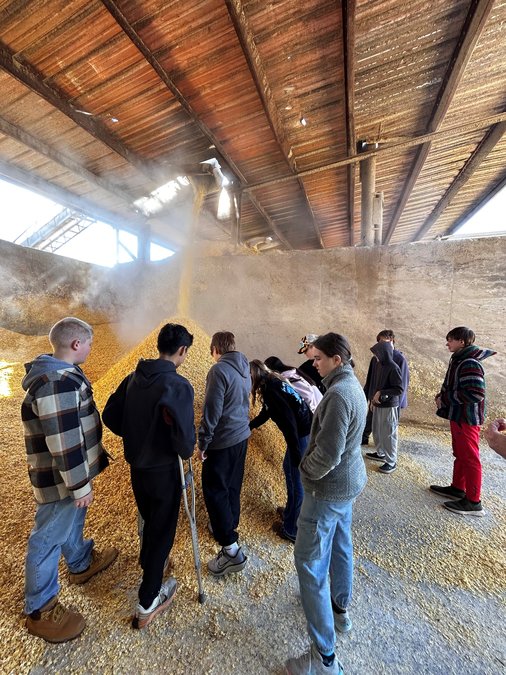
Larned Middle School continually strives to provide the best educational opportunities for its students. This year, the school has implemented a multitiered system of support to better assist every learner in their individual educational journey. As part of this effort, my classes have been working on a student-driven project exploring the journey our food takes from local farms and cattle ranches to our tables. Students have been gathering evidence, examining claims and investigating the food system both locally and nationwide. As part of the project, students recently visited Bert & Wetta and Innovative Livestock Services Feedyard (ILS) in Larned. Both visits offered a firsthand look at the incredible work happening behind the scenes of two agricultural operations that have built reputations extending far beyond our small Kansas community.
A Legacy of Innovation at Bert & Wetta
The story of Bert & Wetta began in 1946 when Ray Bert and Joe Wetta, two Kansas State University fraternity brothers who had served in World War II, reunited in Wichita. Recognizing opportunities in emerging feed-processing technology, they joined forces to manufacture dehydrated alfalfa meal. Their willingness to think differently quickly became a defining characteristic of the business. The founders developed the Field Queen, recognized as the world’s first self-propelled forage harvester. This groundbreaking machinery allowed alfalfa to be cut, chopped and loaded in one operation, dramatically reducing the labor and time traditionally required to harvest the crop. Their innovation attracted orders from across the United States, Canada and Europe. That spirit of innovation has never left the company.
After Carlton and Shari Bert moved to Larned in 1984 to help operate the local facility, the family continued finding ways to improve the industry and the products they offered. Today, Carlton Bert and his son, Weston, continue that legacy, constantly advancing the machinery, processing methods and technology used throughout their operation. During the students’ visit, it was impossible not to be impressed by the level of engineering, attention to detail and thought that goes into the operation. The quality of the finished products is not an accident. It is the result of carefully managed production processes, an understanding of the raw materials and a commitment to maintaining exceptionally high standards.
Bert & Wetta produces premium dehydrated alfalfa products, supplying customers well beyond Kansas. Its products are valued for their nutritional quality, consistency and convenience. The company also has a history of developing specialized products and finding new uses for agricultural resources. Even its approach to energy has demonstrated innovation, with the company converting its dehydrators to use wood waste as an alternative fuel source. But what makes Bert & Wetta particularly fascinating is that its agricultural products reach far beyond traditional livestock feed.
The company also produces certified organic, food-grade green products intended for human consumption. Through its U.S. Greens and Stateside Growers product lines, crops grown and processed in Kansas make their way into the health food and nutritional supplement industries.
These products include alfalfa, barley grass, broccoli, chard, kale, oat grass and wheatgrass. The crops are carefully grown, harvested, dehydrated and milled into products that consumers can purchase, including through Amazon under the Stateside Growers name. It is remarkable to think that ingredients used in human nutrition products across the country can trace their origins right back to our own community.
The quality standards extend to their animal products as well. Bert & Wetta’s alfalfa is produced with exceptional attention to cleanliness, nutritional value and consistency.
Their premium hay is so clean and carefully processed that it appeals to the owners of some of the country’s most valuable horses, including million-dollar animals that deserve only the best nutrition. Their specialized bagged hay offers a cleaner, more convenient product with less waste and easier storage. It is another example of how the company has taken a traditional agricultural product and found ways to make it better.
What began as two men recognizing an opportunity in agriculture has grown into a family legacy that continues to push the industry forward. It is remarkable to realize that some of this innovation, and the products reaching customers across the nation and internationally, originates right here in Larned.
Exceptional Care at Innovative Livestock Services
The second stop brought students to ILS, where they experienced another side of the food system: the tremendous responsibility involved in caring for livestock.
ILS has roots in central Kansas dating back to the 1960s. Its Pawnee County history includes Ward Feed Yard, which began south of Larned in 1962. Through growth, partnerships and the combination of established agricultural operations, ILS has developed into a major cattle feeding, farming and agribusiness organization serving customers throughout Kansas, Nebraska and beyond. One of the most impressive aspects of the visit was seeing just how intentional every part of cattle care is.
Customers from across the country entrust ILS with their cattle, and that responsibility is taken seriously. Caring for livestock is not simply a daily task; it is a commitment that continues around the clock. Every animal requires attention, observation, proper nutrition and care from people who understand the importance of their work.
Students learned about the tremendous amount of planning that goes into something as seemingly simple as feeding cattle. A nutritionist carefully develops feed rations based on the nutritional needs of the animals. Ingredients are selected, weighed and monitored so employees know exactly what is being delivered and how much each animal is receiving. The goal is to provide the appropriate nutrition while monitoring cattle health and performance.
The care extends beyond the cattle themselves. Students even learned about the horses used by the cowboys who work the cattle. Those horses receive carefully managed feed and a day of rest between working days. It was a small detail, but one that spoke volumes about the culture of care throughout the operation. Equally impressive was the emphasis placed on employees. ILS understands that a successful operation begins with the people who make it run. Employees are carefully selected, valued and recognized as individuals. People know one another by name, and there is a genuine emphasis on creating a workplace where employees feel appreciated and take pride in their work.
It takes an incredible team of people working together to maintain an operation of this size. The students were able to see that technology and facilities are important, but it is ultimately the people who make the difference.
A Community Worth Celebrating
These visits were just two pieces of a much larger learning experience. Throughout the project, students have also welcomed several local agricultural leaders into their classroom. Holly Frick of KH Land and Cattle LLC, Marc Johnson of C & J Farming and Jed Fleske have each shared their knowledge and experiences with students. Every guest has offered another perspective on the care, planning and decision-making involved in producing the food and agricultural products we depend on.
Marc Johnson and Jed Fleske helped students understand something that is often overlooked when we think about agriculture: the tremendous financial risks farmers take to provide food for our nation. Farmers can invest thousands of dollars in seed, fertilizer, fuel, equipment and labor, make careful decisions throughout an entire growing season, and do everything within their control, yet still finish the year without making a profit. Weather, markets, input costs and circumstances beyond their control can change the outcome of an entire season. Students began to understand that farming isn’t simply a matter of planting a crop and harvesting a paycheck.
It is a business built on calculated risks, constant decision-making and a willingness to put everything on the line with the hope that the hard work will pay off.
Holly Frick gave students an equally meaningful perspective on the sacrifices involved in raising cattle. She described the realities of calving season, when ranchers may find themselves in the barn in the middle of a snowy night, sometimes spending the entire night making sure a newborn calf is warm, healthy and getting the care it needs.
Those moments don’t follow a convenient schedule, and the responsibility doesn’t end when the workday is over. Behind every healthy calf is often a rancher who has sacrificed sleep, comfort and time with family to make sure that animal gets the best possible start.
Jed Fleske brought another important perspective to the conversation: the responsibility farmers have to be good stewards of the soil. He emphasized that successful farming isn’t just about what a field produces this year, but about protecting and improving the land so it can continue producing for generations to come.
Healthy soil is one of agriculture’s most valuable resources, and taking care of it requires intentional decisions, patience and a long-term commitment. His philosophy of farming with intent was reflected in the words of soil conservation pioneer Hugh Hammond Bennett: “Take care of the land and the land will take care of you.”
Together, these conversations helped students recognize that the people behind our food system invest far more than money and labor.
They invest their time, their livelihoods, their sleep and their personal integrity. Whether it is a farmer making decisions that affect an entire year’s income, a rancher staying up through a freezing night to care for a newborn calf or someone making thoughtful decisions to protect the soil for future generations, there is a tremendous amount of personal responsibility involved in producing our food. Each person has reinforced that successful agriculture requires knowledge, intention, sacrifice and an incredible amount of attention to detail. The integrity of these individuals is woven into every part of our food system.
“I have lived in this community for a decade, and I left these experiences with an even greater appreciation for Larned and the people who call Pawnee County home.
We often hear about the importance of shopping local, supporting local businesses and appreciating our farmers and ranchers. But I wonder how often we truly recognize the level of innovation, expertise and sophistication happening within our own community. We drive past fields, feedlots and local businesses without necessarily understanding what happens behind the gates or inside those facilities. We may not realize that businesses right here in Larned are developing innovative technology, producing premium agricultural products and earning the trust of customers across the nation. We may not see the countless decisions, hours of work and attention to detail that go into caring for animals and producing quality food. Our students got to see that firsthand.
They saw that agriculture is so much more than planting a seed or feeding cattle. It is science, engineering, nutrition, technology, business and, above all, people who genuinely care about what they do. They saw generations of innovation, carefully managed processes, extraordinary attention to animal care and employees who take pride in their work. Perhaps the most important lesson was realizing that you don’t have to leave a small Kansas community to find people doing extraordinary things.
Some of the most impressive agricultural work is happening right here in Pawnee County, and its impact reaches far beyond our county lines. I am incredibly grateful to Bert & Wetta, Innovative Livestock Services and all of the farmers, ranchers and agricultural professionals who have welcomed our students and shared their knowledge. They have given our students more than a field trip. They have given them a greater appreciation for their community and the people who help feed our nation. We truly do have something special here in Larned America!