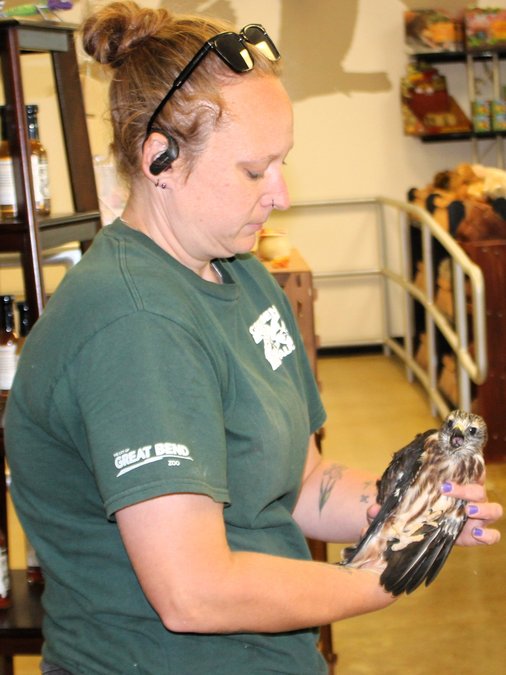
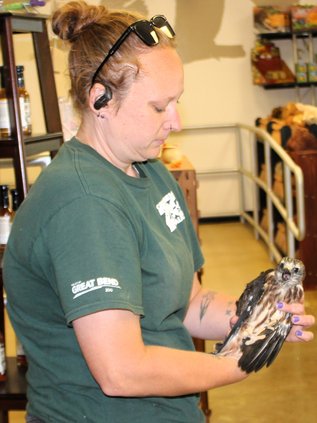
The Great Bend Brit Spaugh Zoo welcomed a young Mississippi Kite on Monday, taking in the small bird of prey for rehabilitation until it can be released back into the wild.
Local residents rescued the Mississippi Kite on Sunday, according to Zoo Director Ashley Burdick, who noted that the zoo’s raptor rehabilitation facility is currently operating at maximum capacity.
“Most of the birds we have are fledglings like this one that are just learning to fly,” Burdick said.
Residents first spotted the young Mississippi Kite in their yard, where it had been sitting for about a week, and cared for the bird by feeding it worms before bringing it to the zoo.
The zoo is currently caring for eight small raptors similar to the Mississippi Kite, as well as three larger birds of prey, according to Burdick.
“Ideally, we try not to rehabilitate more than five because we have five outdoor enclosures,” Burdick said. “With small birds of prey, we can put a few in together because they’re young and they can eat together.”
The rehabilitation process
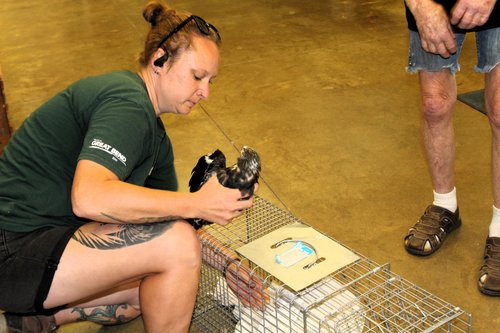
The young Mississippi Kite will remain at the zoo until it is ready for release, a timeline that typically depends on the individual bird’s condition.
“This one’s pretty close to being ready to fly on its own,” Burdick said.
Once the bird masters flying, staff will return it to the wild.
“We try to release them where they are found, unless it’s been shot or poisoned, and then we don’t,” Burdick said. “Sometimes if we have a bunch of these, we’ll release them together, because then they will also fly south here in maybe a month or so.”
The Mississippi Kite
The Mississippi Kite is a slender, medium-sized raptor measuring 12 to 15 inches long with a 3-foot wingspan and weighing between 7 and 14 ounces. Built for agility, its streamlined body, pointed wings and square tail allow it to weave effortlessly through the sky.
As adults, Mississippi Kites feature a pale gray body contrasted by dark, sweeping wings, according to Burdick.
While state wildlife officials do not maintain an exact head count of Mississippi Kites in Kansas due to their migratory nature, long-term monitoring shows the species is thriving.
According to North American Breeding Bird Survey data, Mississippi Kite populations in Kansas have surged nearly 95% over the past several decades.
Once restricted primarily to the southwestern corner of the state, the birds have expanded north and east, becoming a common summer resident across much of central and southern Kansas, according to the Great Plains Nature Center.
Beyond their ecological role, Mississippi Kites and related raptors carry long-standing spiritual significance across the American South and Midwest.
Anthropological records note that Indigenous traditions frequently viewed kites and falcons as spiritual messengers or protective guardians whose presence signaled vigilance and harmony with the sky.