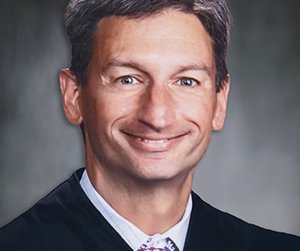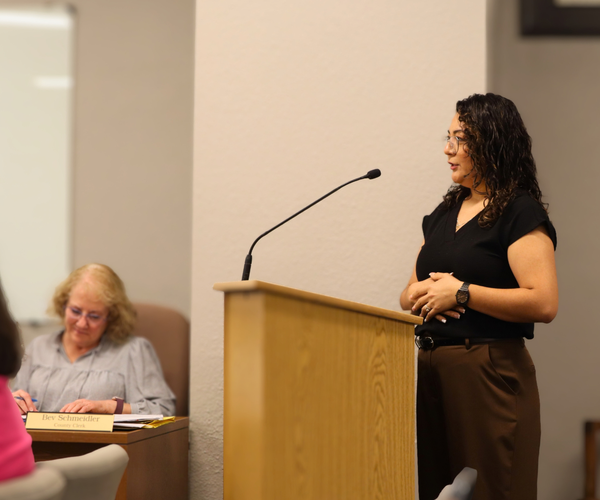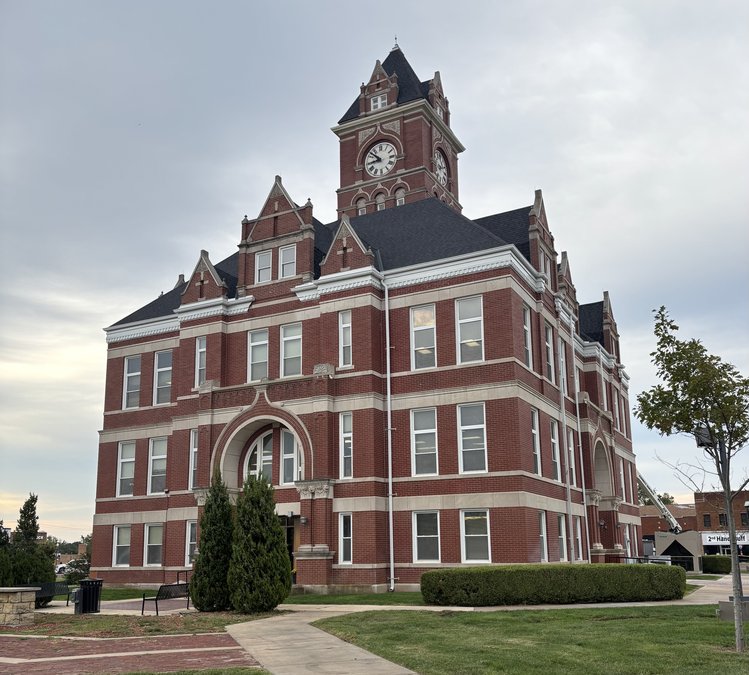
The first day of a preliminary hearing against former Central Kansas Community Corrections officer Katie Norma Hales laid out the scope of allegations Tuesday, Sept. 29, in Rice County District Court. Senior District Judge Glenn Braun, who called the case unusual in both its scope and volume, is considering whether the case should proceed to trial.
Hales faces 90 felony counts involving allegations of forged court documents spanning two counties and, according to testimony and investigative affidavits, more than six years. According to testimony and the charging affidavit, documents containing forged signatures led to people in both Rice and Barton counties being jailed on probation violations, kept under supervision beyond the end of their probation terms or subjected to arrest warrants.
All charges are allegations. Hales is presumed innocent and has not entered a plea.
One prosecution witness, a computer forensic analyst with the Kansas Bureau of Investigation, remains to testify before Judge Braun rules on whether prosecutors have established probable cause to bind the case over for trial.
Before testimony began on Sept. 29, Special Prosecutor Douglas McNett dismissed three Barton County counts, reducing the total from 93 to 90 after law enforcement was unable to follow up with the victim. Judge Braun said it was the largest number of felony charges contained in two complaints he had encountered during his career.
The discovery
Former CKCC Director Amy Boxberger, who spent 26 years with the department, including 18 as director, testified that the investigation began after staff reviewed Hales’ caseload while she was on maternity leave. The review took place while the department was facing public criticism from Barton County Sheriff Brian Bellendir and scrutiny from the Barton County Commission over its handling of probationers, as the Tribune previously reported.
On Aug. 25, 2023, Boxberger’s assistant director, Tyler Lehmkuhl, brought her files from Hales’ caseload as staff divided her cases among other officers. They found what Boxberger and Lehmkuhl described as inconsistencies with normal department procedures.
Among the documents were probation orders with different dates, termination orders alongside extension paperwork and documents that appeared to have been cut, pasted and copied.
The initial concern centered on the digital signature of then-20th Judicial District Judge Carey Hipp, now the district’s chief judge. Lehmkuhl and Boxberger found documents bearing what appeared to be Hipp’s signature that they could not trace to an exchange between Hales and the judge. Boxberger contacted Hipp and asked whether she had signed the documents.
After Hipp could not verify the signatures, Boxberger contacted KBI headquarters in Topeka and requested an investigation.
Boxberger testified she did not contact local law enforcement because Hales’ husband is a detective with the Barton County Sheriff’s Office.
She also did not contact then-Barton County Attorney Levi Morris. Boxberger testified that Morris later told the KBI he wanted a special prosecutor appointed and did not want to be involved in the case.
But the review of Hales’ files raised questions beyond the judicial signatures.
As Lehmkuhl continued reviewing the files, he noticed what he believed were suspicious versions of Boxberger’s signature on multiple documents. Rather than signatures that appeared to have been individually applied, the same image appeared repeatedly.
Those documents extended back several years and included violation reports used to bring probationers back before a judge. Such reports could result in probationers being taken into custody while violations were litigated.
The Judge’s signature
Hipp testified she uses an electronic signature when she does not physically sign documents, referred to in court as a wet signature, and saves a copy to her computer each time she does. She testified that she is the only person with access to her e-file signature, which is stored on her personal laptop and was created using a touchscreen and her finger. Hipp saved her signature and dragged it onto documents as needed. Boxberger testified that she, by contrast, electronically signed each document individually.
The documents identified by investigators were electronically filed in the Rice and Barton County district courts on Aug. 16 and 17, 2023.
Hipp testified that the signature appearing on those documents was one she began using July 27, 2023, after upgrading her Adobe software. The documents themselves, however, carry dates associated with events occurring months earlier. According to the records presented in the case, probationers signed some of the documents between October 2022 and April 2023.
Hipp also testified that, in her opinion, the KBI took a long time to begin moving forward with the investigation.
What the court records show
A Tribune review of the court records introduced as State’s exhibits found chronology consistent with what the investigative affidavit and testimony described.
The records contain instances in which orders placing probationers on supervision were not filed with the court until after the probation term had ended.
In one Rice County case reviewed by the Tribune, a termination of probation dated July 6, 2023, was filed Aug. 16. The following day, Aug. 17, the original order placing the probationer on intensive supervision probation was filed.
That order is dated July 6, 2022 — more than a year before it was filed.
The probationer signed the order’s acceptance page March 14, 2023, eight months into the 12-month supervision term. The order bears the electronic signature Hipp testified she began using July 27, 2023.
Defense attorneys suggested during cross-examination that the gap between the dates on the documents and the filing dates could reflect delayed paperwork rather than forgery. Hipp acknowledged that late filings do not necessarily indicate forgery.
The Tribune is not drawing conclusions about who created or filed the document. That is a question for the court. But the dates in the public record establish that the signature appearing on the order was the version Hipp testified she began using after the order was dated and after the probationer signed its acceptance page.
The same order was not filed until after the probation term had begun and, according to the related termination order, after probation was scheduled to end.
Scope of the alleged harm
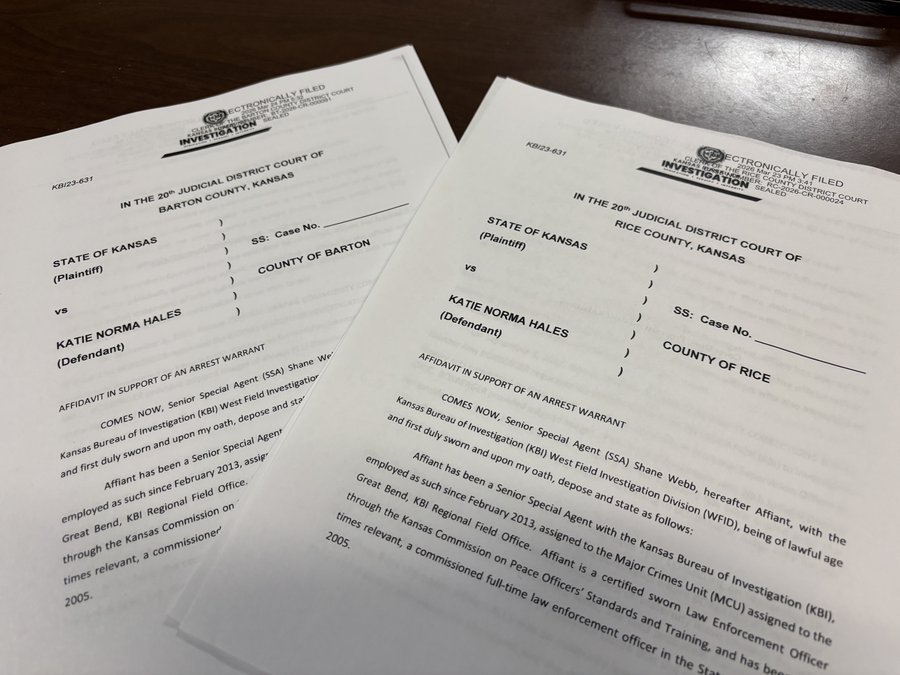
The KBI affidavits filed in support of arrest warrants describe the effects attributed to the allegedly forged documents, including that probationers were held in jail for weeks while awaiting hearings on violation reports.
One Barton County probationer remained in jail for approximately 35 days. Another was arrested and extradited to Kansas at a court-ordered cost of $890 and was ordered to serve 34 days in jail.
Investigators allege that, in that case, the violation report was filed after the probationer’s probation had already ended.
The affidavits also document bond amounts of up to $10,000.
Investigators allege that multiple probationers remained under court supervision after their legal probation terms ended because of orders bearing forged judicial signatures.
A person in prison
Lehmkuhl testified that his review of Hales’ files identified approximately 90 questionable signatures dating back to 2017.
When asked whether anyone was currently incarcerated as a result of a document containing an allegedly forged signature, Lehmkuhl testified that one person was in prison. He identified that person as Jeremy Lamb.
The charges filed in March 2026, however, cover 30 documents.
Kansas law generally imposes a five-year limitations period for the offenses charged in the case. The difference between the approximately 90 questionable signatures Lehmkuhl said he identified and the 30 documents charged raises a chronology issue: some of the documents identified during the investigation may have fallen outside the limitations period by the time charges were filed.
The charging documents and investigative affidavit do not establish that every one of the approximately 90 signatures identified by Lehmkuhl was necessarily a forgery or that every uncharged document was excluded solely because of the statute of limitations.
The investigation
KBI Assistant Special Agent in Charge Shane Webb testified that he first met with Boxberger and Lehmkuhl Sept. 18, 2023, and interviewed Hipp Sept. 25.
Investigators obtained search warrants for Hales’ work laptop and a copy of the CKCC shared network drive. Both were sent to the Heart of America Regional Computer Forensics Laboratory (HARCFL), an FBI-sponsored regional lab in Kansas City where federal and state analysts, including KBI agents, conduct digital forensic examinations.
Webb testified that the KBI contacted the U.S. Attorney’s Office in Wichita around May 2024 to discuss potential civil rights violations arising from the use of allegedly forged signatures on documents that resulted in arrest warrants.
The FBI then assigned Special Agent Amy Kuhn to the investigation. Webb testified that earlier this year, an attorney with the U.S. Attorney’s Office contacted the KBI about the timeline for filing state charges.
Webb subsequently prepared the affidavit supporting the state charges. Webb also testified that he attempted to contact Hales but never spoke with her. She was not interviewed by the KBI.
Federal involvement
FBI Special Agent Amy Kuhn testified that the federal case was designated a civil rights and public corruption investigation. She opened her investigation in July 2024 after the U.S. Attorney’s Office requested FBI involvement.
Kuhn testified that she used federal grand jury subpoenas to obtain court records from Rice and Barton counties. Those records were consistent with what the KBI had already collected, she testified.
She interviewed Boxberger, Lehmkuhl and Hipp and testified that their accounts were consistent with what they had previously told the KBI. Kuhn testified that Boxberger was shocked by the discovery of the suspected forgeries and that neither Boxberger nor Lehmkuhl gave her the impression they were targeting Hales.
Boxberger told Kuhn she had been terminated from CKCC and that there was ongoing litigation. Lehmkuhl was also terminated. Both later reached settlements with Barton County.
Kuhn also testified that she obtained and reviewed minutes from CKCC’s weekly Monday staffing meetings, in which officers discussed probationers and potential violations. While she found references to probationers in the minutes, the actions discussed in those meetings did not always correspond with the actions actually taken, and when action was taken, it sometimes occurred significantly later. Kuhn reviewed only entries related to Hales’ probationers and did not examine whether other officers experienced similar delays.
The case was never presented to a federal grand jury for charges. The federal investigation remains open, but she is not actively working on it.
The forensic evidence
According to the affidavit, the HARCFL report on the laptop and shared drive, received by the KBI in May 2024, identified Enhanced Metafiles — digital image files associated with electronic signatures — on the shared drive. The report concluded that Boxberger’s electronic signature could be placed onto documents using files found on the drive.
Investigators also identified four specific digital files in a folder on the shared drive that they say are directly associated with the alleged Hipp forgeries. The forensic analyst who prepared the report is the final remaining prosecution witness. He is expected to testify by Zoom on a date to be scheduled.
His report and a 50-page presentation have been admitted as exhibits, but the analyst has not yet testified about them or been subject to cross-examination.
The defense
The defense did not dispute Tuesday that documents containing allegedly forged signatures exist. Instead, through cross-examination, defense attorneys Jess and Blaire Hoeme focused on three areas.
First, they questioned witnesses about the condition of the CKCC office during the relevant period, the scrutiny the department was already facing from Bellendir and the commission, and whether the signatures could be the result of late filing rather than forgery.
In spring 2023, Bellendir publicly criticized CKCC’s handling of probationers who failed drug tests and called on the commission to make changes. The commission discussed the issue, its authority over CKCC and the Policy Advisory Board in April 2023. The Tribune reported on the dispute at the time. Boxberger reported the suspected forgeries to the KBI five months later.
Second, they questioned whether Boxberger and Lehmkuhl, who had access to the shared drive containing the digital evidence, had the opportunity to alter or manipulate files and whether institutional pressures could have affected how responsibility was assigned.
Third, they questioned the extent to which the KBI independently verified the allegations made by its principal witnesses. On cross-examination, Webb acknowledged that he did not obtain copies of Hipp’s saved folders, which she testified would show which documents she actually signed. He also acknowledged that he did not independently verify every signature Boxberger identified as forged and did not attempt to determine whether Boxberger or Lehmkuhl had accessed or modified the shared drive before it was collected. When asked why he did not obtain Hipp’s records, Webb testified that she “was not the suspect in the case.”
Hipp testified on cross-examination that she never independently suspected her signature had been misused and that she relied entirely on probation officers to prepare orders correctly.
Current CKCC Director Brooke Haulmark, who took over in January 2024, testified that when she inherited the office, files were scattered, hundreds of assessments were incomplete and it was difficult to determine which officers were responsible for particular probationers.
Braun also indicated that he expects the defense to raise multiplicity arguments — whether prosecutors may properly charge three separate felonies for each allegedly forged document.
He ordered the parties to brief those arguments in writing.
What remains
No date has been set for the forensic analyst’s testimony. His testimony is expected to address the digital evidence recovered from Hales’ work laptop and the CKCC shared network drive, including whether the alleged forgery tools can be tied specifically to Hales.
The defense has not announced whether it will call witnesses, though they indicated they may, potentially including recalling Boxberger.
Once testimony concludes, Judge Braun will rule on probable cause.