In January, the City of Great Bend received a draft print of its 2025 Water System Preliminary Engineer Report. Michael Schultes, PE, with JEO Consulting Group met with city council members on Jan. 19 after their regular agenda meeting to review the document. The city has a contract with JEO for engineering services.
The study includes recommendations for water system improvements to meet the city’s project water needs through 2045.
Starting with the water system, the existing wells need some improvements. The study showed the probable cost would be close to $2 million.
However, additional recommendations for future water treatment are much more.
“These numbers are really scary. They’re big,” Schultes said.
For example, blending the water wells to keep the overall nitrite level at an acceptable level might cost over $26 million. This alternative proposes upgrading the existing control system with a new fully automated PLC (programmable logic controller) control system. Or, a proposal to upsize water mains to create a large-diameter water distribution loop could cost close to $35 million.
One other possibility is to add a water storage tank or tanks to provide storage for treated water. The probable construction cost would be close to $16 million.
The next step
Utilities Director Darren Doonan this year-long study provides a mid- to long-term roadmap for the City. “Nothing will be immediate.”
The City is becoming more proactive to water needs, as opposed to reactive, Doonan said.
It is already doing some of the things the study pointed out. Recently, the Harrison Wellhouse (located between 18th and 19th Street) was rebuilt.
For now, this study shows what the future could hold. When asked, “Do we need a new water treatment plant?” Doonan said, “It’s hard to quantify. It’s definitely a possibility (for the future).”
The level of nitrates is a concern, as high levels can cause Blue-Baby Syndrome. Higher levels are showing up on wells on the west side of town. While the levels are still considered safe, this is one reason the study considers blending the water from the wells, which might require a storage tank.
And there’s the age of the system to consider.
“We’re battling the same things as every municipality in the Continental United States,” Doonan said, referring to the aging infrastructure.
What the study shows
In the draft, which is considered 95% complete, JEO concluded the existing water distribution system currently provides fair service to the community with minimal complaints. The City water maps are relatively old and should be better updated. The physical condition of the water mains appears to be adequate with minimal pipe breaks over time, but it is possible that leaking piping or valves could be contributing to water lost from the system.
Other reports conclusions:
• While the City has sufficient water rights for its existing usage, it should start looking for additional water rights and have options available as water demand increases.
• The City’s water wells are above the secondary contaminant level for Total Dissolved Solids. TDS mainly has an impact on taste and odor of the water. The deposits in the water can have an impact on the infrastructure such as plugging well screens.
• The City does not have an established Wellhead Protection Plan, which is recommended.
• JEO recommends that the City verify the capacity and condition of each of the existing wells. It may be necessary to pull the pumps for cleaning at this time and to inspect the well casing. It is also recommended that the City install back-up power provisions and Wells No. 6 and No. 8, which are the main wells.
City staff report that no well inspections have been performed in recent years. The 10 wells were constructed at different times with the oldest in 1937 and newest in 1985. The average life expectancy of a well is about 40 years.
• Approximately 24% of the water mains are small diameter (4-inch or less). These can cause operational problems that are noticeable.
• There are approximately 528 fire hydrants and 625 gate valves in the distribution system. The estimated 375 non-operational valves should be replaced and additional valves installed to provide better operational and maintenance capabilities. There are approximately 160 problematic or non-functional fire hydrants that should be replaced.
The City manages two separate water systems which are not connected at this time. The main water system serves the city and the second system serves the Westport Addition west of town that includes the airport and industrial park.
Our water supply
The City is located within a regional aquifer system called the High Plains aquifer system. The Big Bend aquifer within this system forms the aquifer under Great Bend. Depth to groundwater below land surface ranges between 100 and 150 feet at the northern part of the aquifer, where the City is located. As for surface water, the major river within the area is the Arkansas River, located south of the community.
The 2020 census population was estimated to be 14,733 people, which equates to approximately 2.3 people per meter. The report notes that the population of Great Bend has fluctuated some in the past 50 years, but it has stayed relatively constant. For the purpose of the engineering evaluation, it assumed a 0.5% annual growth, or a population of 16,689 for year 2045.
There are 6,461 water users on the city’s distribution system:
• 5,806 residential users
• 573 commercial users
• 33 church users
• 20 hospital users
• 25 school users
• 4 government users.
The City does not have any storage facilities and relies on the multiple wells for water system pressures. The original water distribution system consisted of some 4-inch, but mostly 6-inch, cast iron and was likely installed in the early 1900s. Over the years, the distribution system was first expanded with asbestos cement or transite water main, typically between 6-inch and 8-inch diameter. More recently, the distribution system has been expanded with PVC mains.
The current distribution system consists of approximately 500,000 linear feet of main.
“This is usually kind of striking to most people,” Schultes said. “(There are) basically, close to 100 miles of water main that’s buried for the City. You can kind of stretch that from here to Wichita, to think of how much pipe is in the ground here in Great Bend.
“And then if you try to just replace what you got over, like, 100 years – do 1% a year – it’s a mile every year before you would get through just replacing those water mains.”
The City has a total of 10 wells located within the city limits and currently uses six of them for the primary groundwater supply, with capacities ranging from 500-1,200 gallons per minute (GPM). Well No. 5 is contaminated with high levels of perfluoroalkyl and polyfluoroalkyl (PFAS), so it would only be utilized in an extreme emergency situation. Normal system operation is with two wells online, and on peak days three wells may be operating.
The City is currently pumping 65% of the water allowed by its water rights, which allow 964 million gallons per year. The City is in discussions with the Kansas Department of Agriculture’s Division of Water Resources to move 70 million gallons of water rights from Well No. 5 to Well No. 9.
Westport Addition
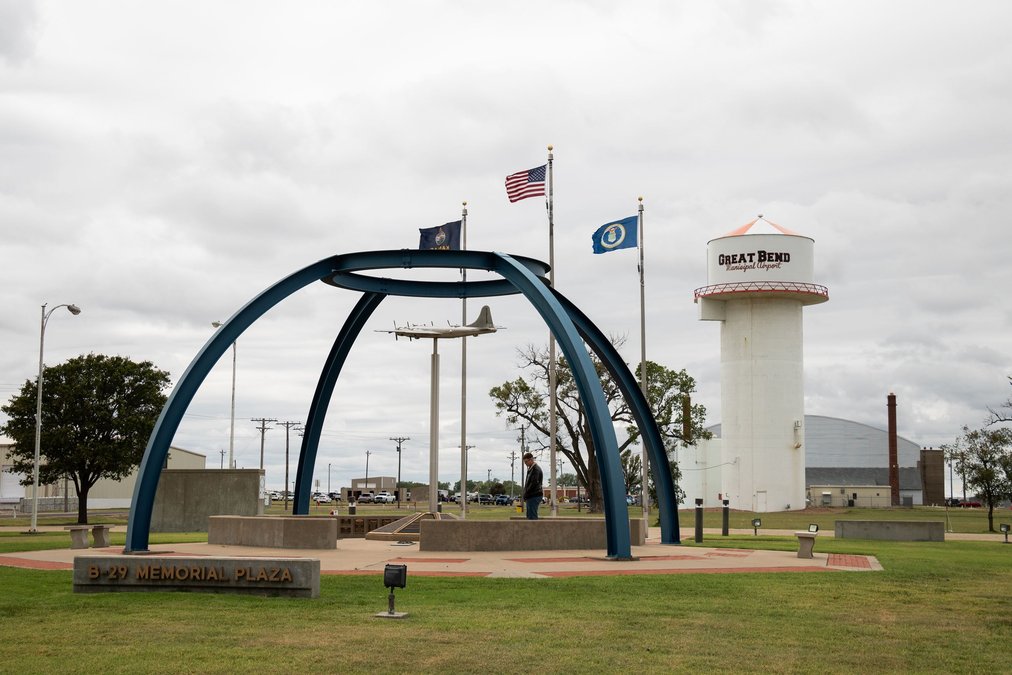
There are no water towers in town. The Westport Addition that includes the airport is a different story.
The City utilizes one elevated water storage tank that has a capacity of approximately 200,000 gallons. The exact age of the water storage tank is unknown, but it is thought to have been constructed with the original water system in the 1940s and is located approximately at the intersection of 6th Street and C Street.
The City also has a ground storage tank that has a capacity of approximately 150,000 gallons. It was originally constructed for additional fire flow with the use of high service pumps. This ground storage tank and the high service pumps are not being used by the City.
The City has two active wells for primary groundwater supply in the Westport Addition system, each with a capacity of approximately 250 gpm. The two wells are blended by combining into one transmission main at the point of entry. The chlorine gas is added in the blending building after they have combined into the single transmission main. Both of the wells are located within City limits. Wells A3 and A4 are located NW of 7th Street and D Street.
The Westport Addition is pumping 67% of the water allowed by their water rights, which allow 54.2 million gallons per year. The water produced in the last year has more than doubled from 2023 to 2024. If the increased water production continues at the Westport Addition, the water rights will be a concern for the City of Great Bend.
Doonan said he will be sitting down with City Administrator Logan Burns and ultimately the City Council to prioritize the recommended projects and determine the next step.
The biggest issues will be where to invest money and where to find grants to meet the challenges of the next 5-10 years.
“We know we’ve got work to do but we’re already doing it,” he said.