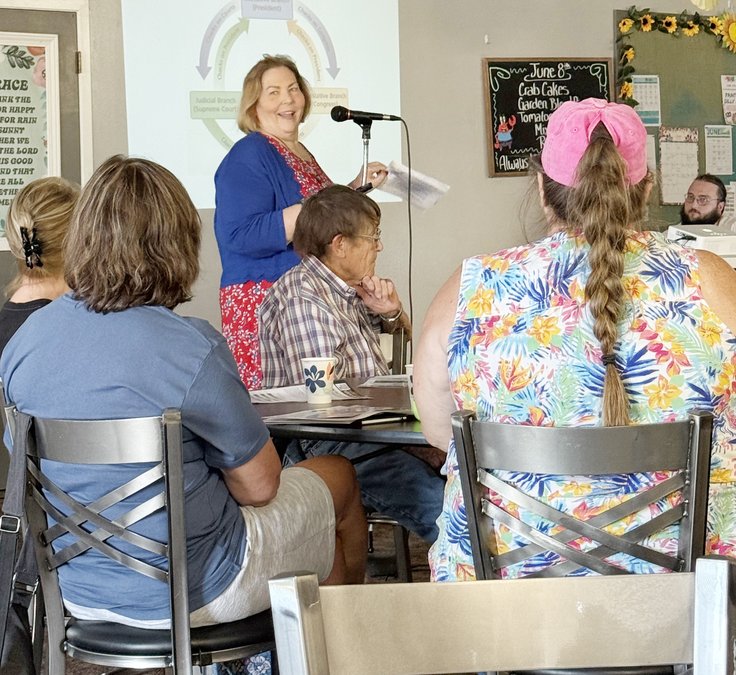
An educational program at the Great Bend Senior Center last week brought together two speakers to examine a proposed Kansas constitutional amendment that would eliminate the state’s current merit-based judicial selection system and replace it with elections for Kansas Supreme Court justices. The amendment, which appeared on a primary election ballot, drew scrutiny from presenters who walked through both the arguments for and against the change.
The speakers were Judge Karen Arnold-Burger, Kansas Court of Appeals, and Logan Stenseng, from the nonpartisan advocacy organization Kansas Appleseed. The speakers shared talking points from both side of the issue, but encouraged people to vote “no” and asked for help in promoting that view.
How the Current System Works
Under Kansas’s existing “merit plan,” a nonpartisan nominating commission reviews applicants and forwards three finalists to the governor for appointment. The commission includes four non-lawyers appointed by the governor — one from each congressional district — four lawyers elected by attorneys within each district, and one lawyer elected statewide who serves as chair. Arnold-Burger described the system as rigorous and transparent. Applicants submit extensive background materials, commissioners conduct public interviews streamed live online, and votes are cast and recorded publicly. “I don’t know how more transparent you can be,” she said.
The process allows anyone to apply, she said. “I’ve been through this process several times. I made the final three ones for the Supreme Court, but I went through it getting on the Board of Appeals, too. You have this huge application packet you fill out. ... They look at everything in this application.”
After background searches and reports, the applicants are interviewed in a public live-stream. The commissioners vote and send the names of three applicants to the governor.
Why the Primary?
Presenters questioned the decision to place the amendment on a primary ballot.
“We know primary elections generally have lower turnout, so why in the world would they put on the primary?” Arnold-Burger asked. “He’s an example; in the 2024 presidential primary, 7% of Kansans voted, but in the regular (election), 59%.”
Supporters of the amendment argued the primary placement would allow any change to take effect sooner. Critics called the choice ironic for a measure framed around expanding voter participation.
The Arguments For
Proponents of the amendment contend the current system concentrates too much power in the hands of lawyers, noting that five of the nine commission members are attorneys. They argue that since less than 1% of Kansans are lawyers, the legal profession holds outsized influence over an entire branch of government.
Arnold-Burger said proponents ask, “‘Should lawyers chosen by other lawyers decide, or should that power belong to all the people?’ They assert that attorneys representing a few influential interests not responsible to the public can control the choice of judges.
“The opponents, the vote no people, say the lawyers on the commission represent a cross section of the state; some are Republicans, some are Democrats, and there’s absolutely no evidence that they vote as a bloc for certain favored applicants, no evidence whatsoever.”
The same question came up in 1958, when Kansas voted to adopt its current system, she said.
“So this fear of what would happen in 1958 has not come to fruition, and I haven’t seen any proof that it has. And this is clearly not the reason they put this on the ballot, because if the reason is there are more lawyers on the nominating commission than non-lawyers, all they had to do was pass an amendment, constitutional amendment, changing the makeup of the nominating commission; make it not majority lawyers, make it no lawyers. If you want, they could have done any of that, and that was placed before them, and they specifically shot that down. So that cannot be the reason. More lawyers than non-lawyers can’t be the reason, because they could have fixed that easily.”
The Underlying Debate
Arnold-Burger noted that the push to change judicial selection has a specific policy backdrop. Attorney General Kris Kobach was quoted as saying Kansans have long wanted a chance to vote on the issue, while Senator Ty Masterson was quoted more bluntly, saying the state is “in a lot of trouble” unless the Supreme Court can be changed to reverse the Hodes decision — the ruling that found a right to abortion in the Kansas constitution. School finance rulings were also cited as motivating factors.
She argued the judicial branch was designed by the nation’s founders as precisely the kind of institution insulated from shifting political winds, and noted that Kansas justices are already subject to a mandatory public retention vote every six years.
Presenters also disputed the claim that Kansas is an outlier in using merit selection. Of 50 states, 22 elect their Supreme Court justices — eight in partisan races, 14 in nonpartisan ones. No state that has adopted a merit selection system, they noted, has ever returned to judicial elections.
Money and the Courts
Stenseng wrapped up the presentation, saying the public needs to be informed before voting in August. He noted that all registered voters can vote, even if they don’t have a primary to vote on. “There’s so much about this issue that a lot of Kansans don’t know,” he said.
He summarized his main points:
- The current system is a merit-based system, adopted by voters in 1958. There is geographic representation on the commission. “One thing that we definitively know – soon as we go to a yes vote, our courts would significantly lose out on the rural voice.” Justice Lee Johnson, who retired in 2019, is from Caldwell; former Chief Justice Lawton Nuss, who retired in 2019, is from Salina; former Chief Justice Marla Luckert, who just resigned, grew up in Goodland; and Justice Dan Biles is from El Dorado.
- We do have a vote, with retention elections.“We’re the ones who voted to create this system (in 1958) in defiance of political corruption,” he said.
- Stenseng pointed to campaign spending in other states as a cautionary example. In Wisconsin in 2025, spending reached $51 million per judicial candidate. Pennsylvania saw $23 million in a 2023 race. North Carolina’s first such election cost $10 million. In each case, a growing share of spending came from special interest groups. “It’s the equivalent of hanging a ‘for sale’ sign on the state Supreme Court,” he said.


