LARNED — George Elmore, longtime Chief Ranger at Fort Larned National Historic Site, was back at his desk and on his computer in the Fort’s Visitor Center last Thursday. The longest federal government shutdown in U.S. history, at 43 days, was over, and there were people to see and plans to make for the remainder of the year.
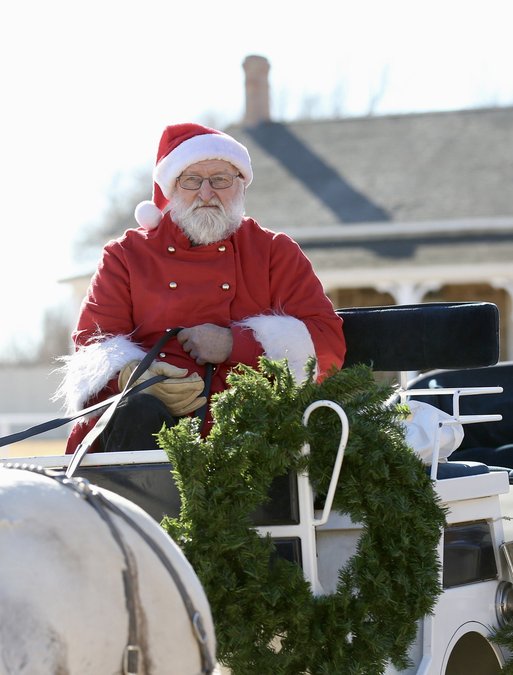
“We were back the next day,” Elmore noted. “We’ve started working on our Christmas Open House on Dec. 13. The Christmas program we’ve had to cancel a few times because of weather, but we are hoping this year won’t be the case.”
The shutdown necessitated the Fort’s closure just days before one of the facility’s most popular annual events, the Candlelight Tour, on Oct. 11. In fact, advance reservation for the evening’s tours had just filled up the day before Oct 1.
Though Elmore and the Fort had experienced government shutdowns in 2019, 2013 and 1995, it was the first time that it had to cancel the Tour in the event’s 50-year history.
“We decided that we couldn’t do the Candlelight Tour,” Elmore noted. “When we missed the date, it’s just almost impossible to try and reschedule it; there’s just too much involved in setting it up. We’ll be looking forward to it for next year.” This year’s Tour was expected to host 250 spectators, with around 70 volunteer living history participants.
Shutting the gate
National Park Service has a protocol for government shutdowns, based on each facility’s “after hours” policy. Basically, if a site has a gate that is closed after regular visiting hours, then it will be tabbed for closure during a shutdown. Other sites that have some facilities open to the public after hours may choose to keep some parts of them open. Fort Larned, meanwhile, was one of the many sites that were completely closed, Elmore noted.
“Everything is locked up, but of course, we have electronic security all over,” he said. “We did have two maintenance guys that took turns in alternating schedules come out to mow grass and make sure that the lights were working.”
Meanwhile, the rest of the staff worked from home on projects while on furlough. The Fort’s staffing fluctuates during the year, with more staff in the summer season. The shutdown affected 12 employees, while two seasonal employees weren’t impacted. Elmore noted that a few of the staff are part-time, at 2-3 days per week. For large events, the Fort relies on volunteers from its Old Guard membership, as well as invited living history participants from the region.
Elmore noted that on reopening day and the day after, the Fort hosted around 40 visitors each day. “About half of those were local, and by local, I mean across Kansas,” he said. “The other half were from out-of-state.
“The weather was beautiful for those two days,” Elmore remarked. “The weather does contribute to visitation. For the community, the whole food, gas and things, that all adds up.”
The Fort’s reopening includes resumption of posts on its website. Elmore, however, noted that discussion with staff resulted in not posting simply resumption of business operations. “We decided that we would focus instead on the Christmas program coming up,” he said. “We will be getting that information out soon.”
Fort Larned is open daily from 9 a.m. to 4:30 p.m. It is located six miles west of Larned on K-156. For information, call 620-285-6911 or visit the website www.nps.gov/fols.
NPS shutdown takeaways
During the 43-day hiatus, the NPS sustained significant impact, including the suspension of most visitor services like trash collection and interpretive programs, reduced safety and sanitation, and increased risks to park resources due to minimal staffing. The shutdown also negatively affected nearby communities, potentially costing them millions daily, and caused demoralization among staff, potentially hurting future recruitment. Despite the temporary nature of the shutdown and the back pay for federal employees, long-term risks to park resources remain, with some advocates fearing damage could be hidden behind a facade of maintained visitor services. Local impact included some states taking steps to keep their parks open by securing state funding or donations.
Financially, the longest government shutdown on record surpassed the 2018-2019 shutdown by eight days. The six weeks and one day cost the travel industry an estimated $6 billion in total, according to the U.S. Travel Association.
Additionally, in 2024, the National Park Service collected about $341 million in recreation fees under the Federal Lands Recreation Enhancement Act. These are the entrance and activity fees that help maintain trails, restrooms and visitor centers across the park system. However, since the government shutdown, parks have been either closed or left understaffed, so many couldn’t collect these fees. The 43-day pause in fee collection could easily mean around millions in lost revenue — money that would have gone directly toward improving visitor experiences and repairing infrastructure.