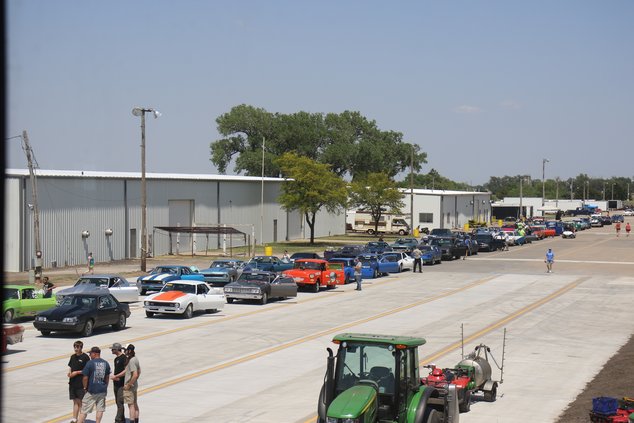
Editor’s note: This is the second in a three-part series examining Great Bend’s proposed STAR Bond project at the SRCA Dragstrip and Expo Complex. Part 1, published June 13, covered what STAR Bonds are, the two-site district structure, and what the city is planning to build. This installment examines the financing mechanics — how the city would borrow, how investors would be repaid, and the economic case behind the project.
At the center of the financing logic behind a STAR Bond project is a simple premise: the project has to generate visitors — and ideally, visitors from outside Great Bend.
That’s not just the city’s goal. It’s the state’s requirement.
The STAR Bond project has been in development since 2022, when Great Bend Economic Development began collaborating with designers to shape what the Expo Complex expansion could look like.
STAR Bond financing was created by the Kansas Legislature in 1999 as a tool for cities and counties to develop major commercial, entertainment and tourism areas.
Kansas STAR Bond projects are specifically designed to drive tourism and out-of-state economic activity.
Kansas STAR Bond projects are specifically designed to drive tourism and out-of-state economic activity. To qualify, a project must demonstrate that at least 20% of visitors will come from out of state and 30% from beyond 100 miles — thresholds set by the Kansas Department of Commerce. For Great Bend, the dragstrip is the primary anchor. But city officials are also banking on other attractions to draw crowds — including a drag racing museum and a new sports and banquet complex designed to host tournaments and events that bring athletes, families, and competitors to Barton County from across Kansas and beyond.
Athletic Complex
The sports and banquet complex would feature multiple courts usable for basketball, volleyball, wrestling, cheerleading, and pickleball, which the city hopes would help attract tournaments and events drawing visitors, especially from out of state. The planned multi-purpose event center would encompass 42,000 square feet with seating for 5,000, alongside a 12,000 square foot banquet hall tailored for sporting tournaments, concerts, conventions, and social gatherings.
The project plan also calls for a drag racing museum as part of the Expo Complex expansion.
The city’s feasibility study projects the completed first phase could draw between 340,000 and 480,000 visitors annually at stabilization — a number that must meet the state’s out-of-state visitation thresholds to maintain STAR Bond eligibility. Should future phases including a livestock arena and outdoor amphitheater be completed, that projection rises to between 560,000 and 730,000 annual visitors.
The state really stresses multi-functional sports facilities because you’re trying to bring in out-of-state visitorsGreat Bend City Administrator Logan Burns
“The state really stresses multi-functional sports facilities because you’re trying to bring in out-of-state visitors,” Great Bend City Administrator Logan Burns said. “If you can have state basketball tournaments, volleyball, wrestling — that’s where you maximize it. The size of the courts depends on what spits out enough additional revenue to pay STAR Bonds off.”
Burns said four courts are currently modeled in, but that number could scale up to six, eight, 10, or even 12, depending on what the revenue projections support. Sara Arnberger, who departed as Great Bend Economic Development president last year in July and now operates Hayden Growth Strategies, had previously referenced eight courts as a planning aspiration for the complex during a city council work session. Arnberger is now working with PETRA, the development company involved in the STAR Bond project at the Expo Complex.
How the Financing Works
The financing structure has gone through multiple iterations – Burns described this as scenario five at a recent presentation to the Barton County commission — but the current version works as follows:
The city would issue approximately $30 million in temporary notes to fund construction of the dragstrip improvements and athletic complex. Temporary notes are short-term borrowing instruments where the city pays interest only, with no principal payments, for up to four years. That window gives the hotel, restaurants, and dragstrip time to open and establish a proven revenue history.
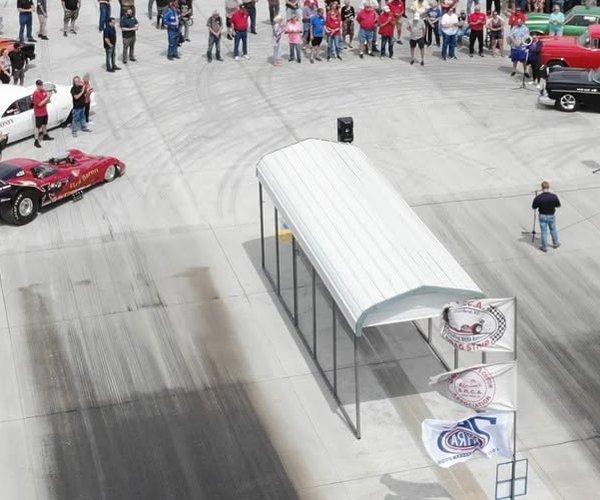
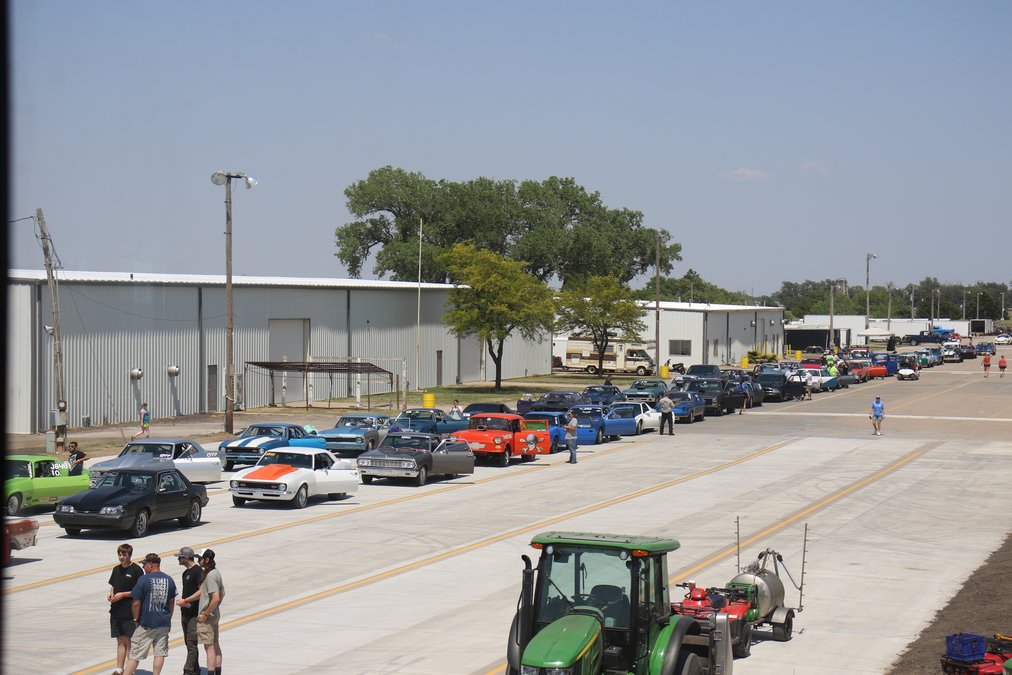
The dragstrip’s first season back offers an early indication of that potential — the SRCA is hosting events across roughly 16 weekends in 2026, including nine Summit Points races, two Rocky Mountain Race Week competitions, and four NHRA-sanctioned events running from May through October.
Once revenues are being generated and demonstrated, the city would issue STAR Bonds — selling them to private investors. Those investors are repaid using the sales tax increment generated above the baseline within the district, rather than through any direct city obligation. Burns said the current scenario projects approximately $12.095 million in STAR Bond proceeds. Those proceeds are then applied against the temporary notes, reducing the city’s permanent debt load. What remains becomes the city’s permanent general obligation bond (GO bond) — currently projected at approximately $16 million — with an annual debt service payment of roughly $1.3 million.
At full operation, the project is projected to support approximately 400 permanent jobs across the dragstrip, event center, banquet hall, hotel, and restaurant components.
That $1.3 million annual payment comes due every year regardless of how the dragstrip performs.
“That bond payment comes hell or high water every year, no matter what,” Burns said. “The only way you cover it if the dragstrip doesn’t make it is property taxes or pulling from something else.”
The debt service coverage ratio on the STAR Bond side is set at 1.4, meaning projected revenues must be at least 1.4 times the annual bond payment before STAR Bond investors will participate. Burns said that ratio is likely a floor.
Canyon Research Southwest conducted the demand projections underlying the financial model. Those projections show STAR Bond revenues beginning in 2028 and growing steadily. Burns said he views the 100% projection figures as a best-case scenario and would prefer to plan around the 50% figures.
“This is 100% projected revenues from the feasibility study,” he said of the optimistic scenario. “I want to make sure their numbers are not inflated where they give us a false representation.”
Money maker
The financing structure, on paper, is designed to work. The city borrows, builds, and generates revenue. Then STAR Bonds are issued, reducing the city’s permanent debt load. What remains is a GO bond the city expects to service through a dedicated sales tax — with operating profits from the dragstrip and complex serving as a potential supplement.
We know the dragstrip is the money maker. That’s the biggest thing with all of thisLogan Burns
But the entire structure rests on the assumption that the dragstrip, the athletic complex, the hotel, and the restaurants perform at levels sufficient to generate the sales tax revenue needed to make it work.
“We know the dragstrip is the money maker,” Burns said. “That’s the biggest thing with all of this — it has to make money in order to survive.”
Whether Great Bend has the financial backstop it needs to ensure that survival is the subject of Part 3 of this series.