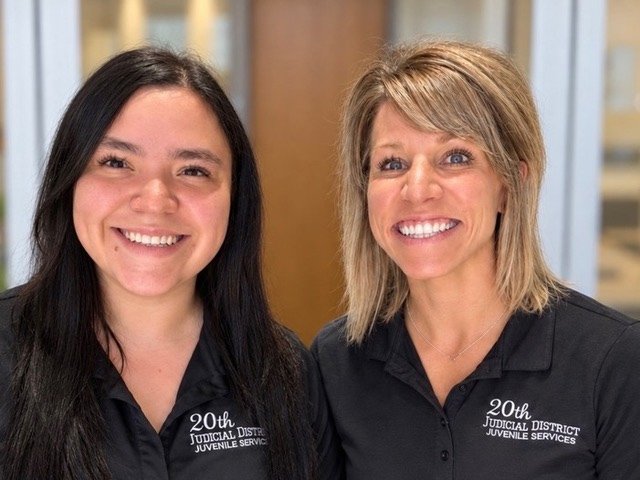
When Blakelee Cooper and Paulina Martinez talk about how technology enhances their effectiveness on the job, they zero in on the extensive time savings that result in better support of their clients at Juvenile Services (JS).
Cooper and Martinez are community case managers at JS who, along with their colleagues, recently participated in a pilot program that offered a smart-phone-based platform for client supervision.
The name of the technology is RePath, which allows them to communicate with clients any time of the day or night.
“RePath has truly changed how I do my job,” Cooper said. “It hasn’t just improved supervision, it has transformed it. I am more confident and more connected with my clients, and much more effective because I have the tools to respond in real time.
“I know where my clients are, who they are with and what they are doing. Instead of guessing or relying on self-reports, I can actually see what is going on. This makes a huge difference.”
For example, case managers can determine if a youth is skipping school, breaking curfew, hanging out in at-risk situations or showing signs of substance use.
On the other side of the coin, “it gives me real-time opportunities to tell them they are doing a good job and that I am proud of them,” Cooper added.
She also noted that when clients know they will be someplace out of the ordinary at a certain time, they can give their case manager a heads-up.
Since the pilot program has ended, JS is now in the RePath beta-testing stage. “We test new technology and give our recommendations to RePath,” Cooper explained. “They help us find ways to better manage our day-to-day responsibilities, which in turn, makes us more available to clients.
“We can focus on individual needs instead of being bombarded with paperwork. I can’t imagine going back to life before RePath. It’s not just about compliance; it’s about connection, growth and giving youth a real chance to succeed.”
Time savings
Local and national figures indicate an average of 40 hours are saved per month for each case manager because of far less pen-to-paper documentation.
One of the main examples is that RePath electronically records and transcribes conversations during clients’ office visits with case managers.
Paulina Martinez explained this summary includes an overall narrative of the conversation, along with some added highlights.
“The summary gives us a basic outline of the visit but RePath doesn’t stop there,” Martinez said. “It also offers a recap in quite a few categories so that we can further understand our clients’ situations.”
These categories include family; drug and alcohol use; emotional stability; school discipline; educational/vocational performance; peer relationships; employment; economic status; sexual behavior; physical health; community service; restitution; and special conditions.
“RePath’s outlines in these categories let us concentrate on areas where we are most needed,” Martinez commented.
Other RePath offerings include: “Breaking Free,” which provides substance-use help online; and a coaching feature that points out to case managers what went well during an office visit, along with recommendations for the future.
“All of us are grateful for this technology,” Martinez said. “Detailed documentation was a draining part of the job. We had to type notes, highlight key takeaways from a meeting and enter everything in the case-management system.
“This resulted in long hours and backlogs that were difficult to overcome. Now, thanks to this technology, we can devote to our clients the time they need and deserve.”
20th Judicial District Juvenile Services empowers youth in Barton, Rice, Ellsworth, Stafford and Russell counties to achieve positive outcomes by offering Juvenile Intake & Assessment, Immediate Intervention, Intensive Supervised Probation, Case Management, Journey to Change, Life Skills, All Stars and Youth Crew. Parents and guardians also are offered The Parent Project. Visit 1800 12th in Great Bend or call 620-793-1930.