EDITOR’S NOTE: The Great Bend Tribune has been investigating Great Bend Economic Development Inc. since November 2025, when construction on the IGNITE Innovation Center was paused and questions arose about how the organization operates. This is the first in a series of reports on those findings. The Tribune filed multiple public records requests, reviewed state and federal filings, and met separately with GBED representatives and city officials.
The Kansas Attorney General has ruled that Great Bend Economic Development Inc. is not subject to the state’s open records law, closing a formal complaint filed by the Tribune and leaving residents without access to the organization’s meeting minutes, correspondence, and broader governance records. Meanwhile, a separate Kansas statute still requires disclosure of how public funds were received and spent — a narrower obligation the organization has not yet fully addressed.
The City of Great Bend has directed more than $1.6 million in public sales tax revenues to GBED since 2020, according to city budget records.
Barton County contributed an additional $250,000 annually from 2022 through 2024 and approved a $435,714 grant match for a childcare facility in March 2022, bringing combined local public contributions to more than $2.8 million.
How GBED was created
Great Bend Economic Development Inc. was established in October 2019 by a formal vote after the city council ended its economic development agreement with the Great Bend Chamber of Commerce. A mayoral committee had concluded that the existing approach was “flawed and needs to be reinvented,” according to June 2019 council minutes.
The organization was formed as a membership corporation with two members — the City of Great Bend and the Chamber of Commerce. In October 2021, the city approved bylaw amendments and appointed then-Mayor Cody Schmidt to represent the city in adopting those changes.
City funding comes from a dedicated half-cent sales tax that allocates 20% of its revenues specifically to economic development incentives. Barton County’s contributions were approved through the annual budgeting process under the county’s economic development line item.
Barton County joined as a funding partner in November 2021, receiving a seat on the board and on the director selection committee. Commissioner Shawn Hutchinson called it “a special day” and hailed it as a historic cooperative effort between the county and the city. “The county will be having a seat on this committee so that we will be able to watch how our money is spent,” then-Commissioner Jennifer Schartz said at the Nov. 2, 2021 meeting.
That oversight role has since been eliminated. Through a board resolution, GBED barred all elected officials from serving on its board. No elected official currently holds a seat, and none are permitted to do so — meaning the city and county that together have contributed more than $2.8 million in public funds have no elected representative on the board overseeing how those funds are used.
Commissioner Hutchinson resigned from the GBED board in December 2024, telling the Tribune in December 2025 that concerns about transparency led to his decision. The county shifted to project-based funding at the end of that year.
Records requests denied
In November 2025, the Tribune submitted records requests to both the City of Great Bend and GBED seeking financial documents from the organization, which describes itself as a “public/private partnership,” along with budgets and meeting minutes.
A request filed with the city under the Kansas Open Records Act was denied by City Clerk Shawna Schafer, who said the city did not possess the requested records because GBED is a separate entity. She directed the Tribune to the city’s budget book, which lists annual funding allocations but does not include the detailed financial records or meeting minutes requested.
On the same day, a records request submitted directly to GBED under KORA was denied by Executive Director Jason Kuilan, who wrote: “As a contracted vendor with the city we don’t fall under KORA. If you have any additional questions you can reach out to our attorney, Mark Calcara, at Watkins Calcara, CHTD.”
The Tribune then requested the contract between the City of Great Bend and GBED. The city responded by providing a copy of GBED’s bylaws — the organization’s internal governing document — rather than a formal contract. The bylaws show that rather than operating as a contracted vendor, GBED was established as a membership corporation in which the City of Great Bend is a founding member with voting rights, veto power over bylaw amendments, and a structural role in the organization’s continued existence. No formal contract governing the city’s financial relationship with GBED was produced in response to the Tribune’s request.
A separate records request to GBED, filed Nov. 12, cited K.S.A. 45-240 — a Kansas law requiring nonprofits receiving $350 or more in public funds annually to document how those funds are received and spent and to disclose those financial records upon request, regardless of whether the organization is subject to KORA. The statute applies specifically to financial records and does not extend to meeting minutes, board resolutions, or other governance documents.
Calcara responded by stating the organization is not governed by KORA The Tribune later met with GBED representatives, including Calcara, on Dec. 8, 2025, reviewing financial information related to the Innovation Center project and the structure of the organization and its subsidiaries. The meeting did not address the full scope of the records request. Calcara subsequently said the organization believes it complied with K.S.A. 45-240 through that meeting and will continue to comply “to the extent required by law.”
...we are not governed by KORA. Is there something particular you would like to know? Happy to visit when I get back.GBED attorney Mark Calcara, in response to Tribune records request, Nov. 12, 2025
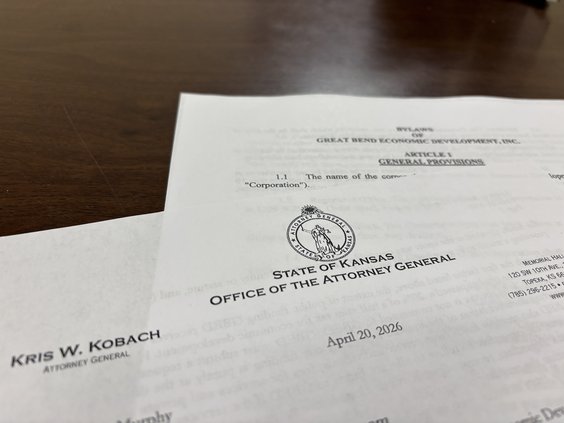
The Tribune filed a formal complaint with the Attorney General’s Open Government Enforcement Unit on Nov. 21, 2025. The complaint was acknowledged by the AG’s office November 24, formally presented to GBED in March 2026, and closed with an April 20 determination.
The AG determination
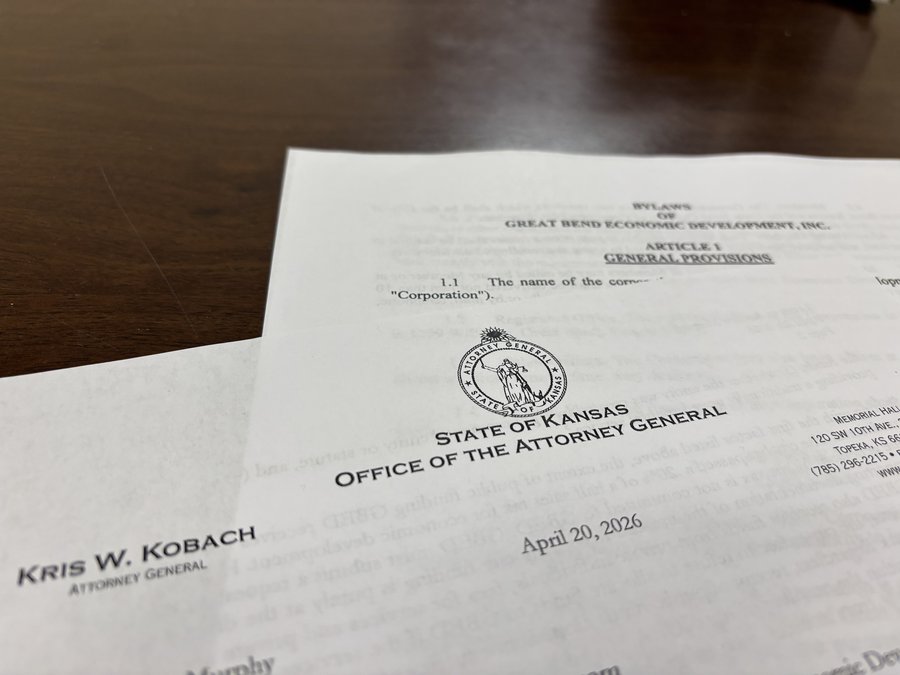
In an April 20, 2026 letter, Assistant Attorney General Braelyn Cummings determined that GBED is not a public agency within the meaning of the Kansas Open Records Act. The decision applied a four-factor test — the extent of public funding, whether a specific service is provided for the funds, whether the entity was created by a governmental entity, and whether it provides a traditionally governmental service — and found the balance did not support requiring GBED to open its records to the public.
The complaint was closed, with the AG’s office noting the determination was limited to whether there had been a knowing or intentional violation of KORA based on the specific facts presented. The AG’s review did not examine compliance with K.S.A. 45-240.
Attorney General KORA four-factor test
- Factor 1 — Public funding: The Attorney General found GBED's city funding is conditional and discretionary, and that receipt of public funds alone is not sufficient to qualify as a public agency.
- Factor 2 — Specific services: The Attorney General found GBED provides specific services for the city as an independent contractor.
- Factor 3 — Governmental creation: The Attorney General acknowledged GBED was created in part by a governmental entity — specifically the City of Great Bend — along with the Great Bend Chamber of Commerce.
- Factor 4 — Governmental service: The Attorney General found that although GBED was created by the city, it does not provide a strictly governmental service. "Historically, economic development was controlled by the private sector," the letter states.
Max Kautsch, a Lawrence-based attorney specializing in First Amendment and open government law, called the determination disappointing and questioned whether it would withstand a legal challenge. Kautsch said three of the four factors weighed in favor of treating GBED as a public agency. “The city’s choice to form GBED as an express public/private partnership to promote economic development differs from most other economic development organizations in this state, which are privately formed, and that choice should have legal consequences,” he said. Kautsch also argued that the city’s involvement effectively preempted private sector economic development in Great Bend, undermining the AG’s reasoning on the fourth factor. “Under these facts, it is reasonable to wonder whether the AG’s position on this matter would hold up in court.”
Transparency questioned
Questions about transparency emerged months before the Innovation Center funding shortfall became public.
At a February 2025 city council meeting, council member Kevyn Soupiset — who had served as the city’s appointed representative to the GBED board before leaving that role — described GBED as transparent and accessible during a council discussion about why Barton County had switched its funding approach. In an April 2026 response to the Tribune, Soupiset said he stood by that assessment, noting that annual financial reports had been presented to the council. “GBED has assured the council, moving forward, that quarterly reports will be presented,” he wrote. Soupiset also confirmed he did not disclose to the full council that he had left the GBED board prior to the Feb. 18 meeting. He said his departure followed a board resolution requiring elected officials to resign their positions.
City attorney Allen Glendenning, of Watkins Calcara Chtd., discussed the question of whether GBED is subject to KORA and the Kansas Open Meetings Act at length during a December 2025 meeting with the Tribune, describing it as “frankly an interesting legal question” with “a lot of interesting legal issues.” Glendenning also confirmed that while the city as a corporate member has the right to inspect GBED’s books and records, the public has no equivalent right under the corporate bylaws.
In an April 2026 written response, Glendenning said the “interesting legal question” comment was a personal observation and not a legal opinion, and cited the AG’s determination as providing the answer to the applicability question.
What the bylaws show
The bylaws reveal a structure that goes well beyond the language of a typical private nonprofit. The City of Great Bend is one of two co-founding members, with equal voting authority. Any bylaw amendments require approval from both members, giving the city effective veto power. The bylaws also invoke the Kansas Open Meetings Act, stating that meetings shall be governed by K.S.A. 75-4317 “to the extent applicable” — language that would be unnecessary in a purely private organization.
The bylaws further require GBED to provide quarterly financial reports to its members detailing assets, liabilities, receipts, and disbursements. The Tribune found no evidence those reports were consistently produced.
“The quarterly reports were not done,” Glendenning said in the December 2025 meeting, describing the issue as an oversight that was being addressed.
City Administrator Logan Burns said he was not aware of the reporting requirement until it was brought to the city’s attention — six years after the city signed the bylaws containing it. City Clerk Shawna Schafer confirmed in April 2026 that quarterly reports had not been submitted to her office and that the first is expected in May 2026.
GBED officials said they believe they have met reporting requirements through annual financial presentations and other communications with the city and Chamber.
Officials and GBED representatives response
Kuilan said GBED is in compliance with the bylaw provision, arguing that annual financial information provided during funding requests and quarterly meetings with the Chamber executive committee have satisfied the requirement.
GBED board chair Paul Snapp said the AG’s determination confirmed GBED’s position. “Only public agencies are subject to the Kansas Open Records Act,” he wrote. “GBED is not a public agency, as confirmed by the AG recently, and therefore not subject to KORA.” Asked whether quarterly financial reports required by the bylaws were ever produced during his tenure as board chair, Snapp did not directly answer the question. “GBED has provided various financial information to the City of Great Bend and the Great Bend Chamber of Commerce and to my knowledge the City and Chamber have been satisfied with the information received,” he wrote. “If the City or Chamber requires different reporting, GBED will be happy to comply.” Snapp confirmed GBED submitted a 19-page response to the AG’s complaint letter contending the organization is not subject to KORA. “The AG has concurred and confirmed that GBED was correct in its assertion,” he wrote.
Glendenning said in an April 2026 written response that while the quarterly reports called for in the bylaws were not furnished, annual financial information was provided each year and GBED’s director appeared regularly before the council.
Calcara said GBED believes it complied with K.S.A. 45-240 through the Dec. 8, 2025 meeting at which GBED representatives spent nearly three hours walking the Tribune through Innovation Center receipts and expenditures. GBED “will, to the extent required by law, continue to comply” with the statute, Calcara wrote.
“I was not aware of the requirement for submitting quarterly financial reports until the oversight was brought to the City’s attention,” City Administrator Burns wrote. The requirement has been in GBED’s bylaws since the organization was founded in October 2019 — predating Burns’ tenure as well as that of his predecessor. City Clerk Schafer confirmed in April 2026 that quarterly reports had not been provided to the city clerk’s office until the oversight was identified, and that the first quarterly report is expected in May 2026.
Sara Arnberger, who served as GBED’s president from 2020 through July 2025, declined to answer questions about her tenure when asked about the quarterly reports, saying it would be inappropriate to respond as she no longer holds the position. She directed questions to Kuilan.
Hutchinson declined further comment on GBED. “At this point I believe I have said all that needs to be said regarding Great Bend Economic Development,” he wrote in April 2026.
The accountability gap
The result of the AG’s ruling, the removal of elected officials from the board, and the absence of a formal contract presents a specific gap in public accountability: more than $2.8 million in public funds has flowed to an organization whose governance records — board minutes, internal resolutions, correspondence — are not accessible to the public under state law.
K.S.A. 45-240 requires disclosure of how those funds were received and spent. Following the Tribune’s request on April 27, 2026 GBED confirmed it will provide documentation of public fund receipts and expenditures for the organization and its subsidiaries going back to January 2022, in accordance with the statute. The organization indicated it will require advance payment of reasonable costs before producing the records.
The commitment to provide formal documentation follows GBED’s earlier position that its December 2025 meeting with Tribune reporters — in which representatives walked through Innovation Center receipts and expenditures — had satisfied the organization’s obligations under K.S.A. 45-240.
What comes next?
The Attorney General’s ruling addresses whether GBED is subject to the Kansas Open Records Act, but questions remain about whether that determination would withstand a legal challenge and whether the organization has fully complied with separate disclosure laws governing public funds.
Calcara, Glendenning, former Mayor Schmidt, City Administrator Burns, City Clerk Schafer, council member Soupiset, former council member Biggs, former council member Urban, GBED executive director Kuilan, GBED chair Snapp, former GBED president Arnberger, and Barton County Commissioner Hutchinson were contacted for comment. Former council member Biggs declined to comment. Former Mayor Cody Schmidt and former council member Cory Urban did not respond to requests for comment.
Documents reviewed for this report include City of Great Bend records, city council and Barton County commission meeting minutes and video recordings, city budget documents, filings with the Kansas Secretary of State, and nonprofit financial data available through ProPublica. This is the first in a series of reports on the Tribune’s investigation of GBED.