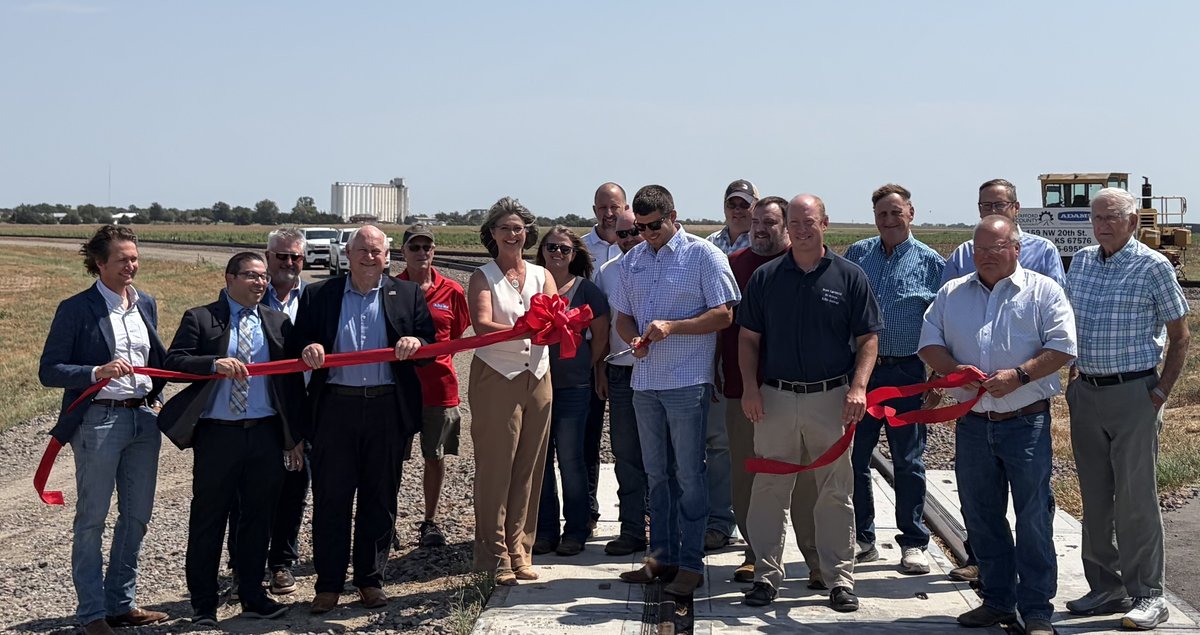
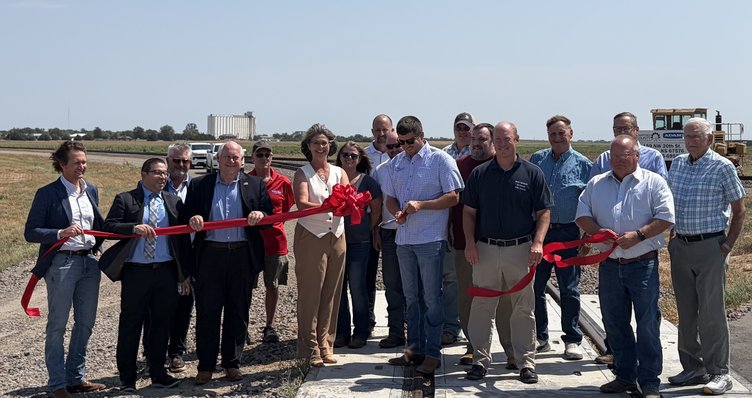
ST. JOHN — More than a decade of planning, fundraising, and advocacy culminated Tuesday when federal, state, and local leaders gathered in St. John for the ribbon cutting of the Stafford County Port Authority, a rail-served transload facility that supporters say will reshape the economic outlook for central Kansas.
U.S. Senator Jerry Moran, Congressman Ron Estes, State Rep. Brett Fairchild, and dozens of community members turned out for the Aug. 11 ceremony, which began with remarks at the St. John Annex building before moving to the facility site southwest of town.
The project, which connects local agriculture and business to the BNSF mainline, allows full unit trains to load and transport grain locally — lowering shipping costs for producers, reducing heavy truck traffic on county roads, and opening new possibilities for private investment.
Carolyn Dunn, president of the Port Authority of Stafford County and strategic projects manager for Stafford County Economic Development, is widely credited as the driving force behind the effort. She traced the project’s origins to 2013, when county leaders recognized they were missing business opportunities and needed bolder strategies to grow the tax base and population.
“This project has been 13 years in the making,” Dunn told the crowd, drawing a parallel to the 13 years between the first shots of the American Revolution and the ratification of the Constitution. She emphasized that the facility would remain a public, multi-tenant operation, not controlled by any single business. “We have a public court if we can keep it,” she said, echoing Benjamin Franklin’s famous remark about the republic.
The Stafford County Commission — Jim Stanford (District 1), Todd A. Wycoff (District 2), and Bryce Garner (District 3) — has supported the project throughout its development. Garner, who also serves as an officer on the Port Authority Board of Directors, highlighted a point of particular pride at the ceremony: the project was completed without any increase in local property taxes.
“As a county commissioner, we hear a lot about our declining tax base and the property tax burden on our local constituents,” Garner said. “One thing we’re really proud of with this project is that today we don’t have any local property tax in this.”
The roughly $40 million project was assembled from multiple funding sources over several years. A $2.5 million state grant was followed by $2.5 million in federal American Rescue Plan Act dollars secured through the state budget. Fairchild said he helped arrange a meeting between Dunn and House Appropriations Chairman Troy Waymaster that proved pivotal in landing that ARPA funding.
“This didn’t cost taxpayers an extra dime — this was federal funding that was going to be spent somewhere regardless, and we made sure it came home to rural Kansas,” Fairchild said.
Sen. Moran sponsored a $5.366 million congressionally directed spending request, and his office also lobbied the U.S. Department of Transportation for approval of a $25 million BUILD grant that had previously been rejected. A $5 million allocation from the Build Kansas Fund, established by the state legislature and signed into law by Gov. Laura Kelly in 2023, provided the required non-federal match for the federal grant.
Jason Fizell, representing the Kansas Infrastructure Hub, noted the leverage that state match dollars provided. “Every one dollar in state match funds helped bring in five dollars in federal funding to the project,” he said.
Moran framed the project in terms of agriculture’s future and rural Kansas’ ability to compete globally. He pointed to Brazil’s infrastructure investments as a competitive threat to Kansas producers and said transportation infrastructure is essential to maintaining access to world markets.
“America would be a totally different country if you didn’t have the middle of the country, from North Dakota to Texas, and it was only the east coast or the west coast,” Moran said. “We better do everything we can to make sure that there’s a brighter future here.”
Estes, who said the project was one of the first things he discussed with Dunn after taking office nine years ago, emphasized the broader regional impact. He said the facility would deliver cheaper transportation costs, better leverage on grain prices for area producers, and attract additional business growth to the region.
Dunn used her remarks to advocate for more equitable treatment of rural communities in federal competitive grant programs, calling it “the hill I will die on.” She argued that scoring criteria favoring large job numbers structurally disadvantage rural applicants and funnel dollars to urban areas.
Adams Industries, led by President and CEO Zach Adams, will serve as the port operator. Dunn said the company was introduced to the project through an agriculture industry contact and impressed local leaders with a corporate culture that is “both ambitious and professional, and at the same time rooted in small town culture.”
Other key partners recognized at the ceremony included the Stafford County Economic Development Board and its executive director Ryan Russell, ASM Engineering Consultants, the Federal Railroad Administration, BNSF Railway, Ameritrack and Kansas Dirt.
A second phase of development is planned, supported by remaining federal and state funds.