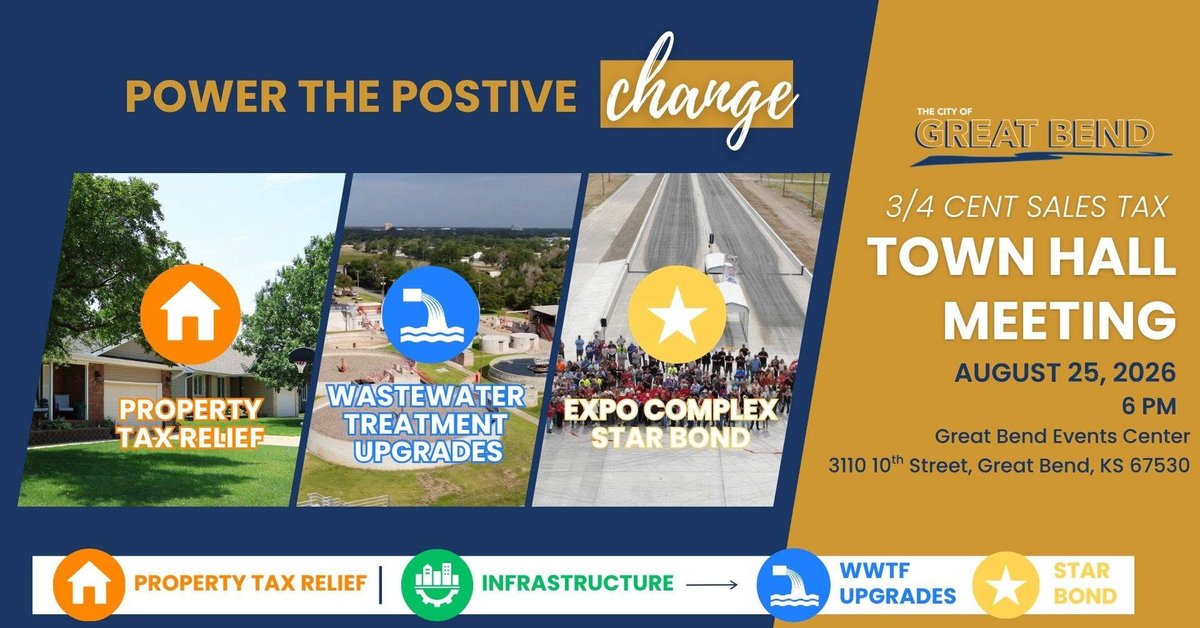

Great Bend voters will decide in November whether to approve a permanent 3/4-cent sales tax to fund city infrastructure and provide property tax relief. The Great Bend Tribune met with Mayor Alan Moeder on Thursday for a two-and-a-half hour conversation to discuss the proposal and questions residents may have before attending Tuesday’s town hall (6-8 p.m.) and ultimately casting their votes. City Administrator Logan Burns joined the interview after completing a prior commitment. The Tribune opened the interview with a question that reflects what many residents are asking in the community:
Residents paid utility rates they were told would maintain the sewer system. They approved sales taxes they were told would fund capital improvements. They absorbed rate increases they were told would fix the problem.
Now you’re telling them it’s a crisis — and the solution is a permanent new sales tax bundled with a speculative development project, with no guarantee the same mistakes won’t happen again. And the public’s opportunity to weigh in comes after the council already put the question on the ballot — not before.
How do you respond to that? Their answers — and what 16 years of the city’s own audited financial records show — form the basis of this report.
Moeder acknowledged combining all three components into a single ballot question was a deliberate choice. “Instead of confusing people with three different sales taxes, just put it out there in one go,” he said. “That was my decision. I’ll admit it.”
We have an opportunity for growth right now that we’ve never had before. We either grab it and go with it, or we sit back and watch the town keep shrinking. I’m going for the growth. That’s where I’m at.Mayor Alan Moeder
Infrastructure
Great Bend’s wastewater treatment facility processes approximately 1.2 million gallons daily. It last underwent a major overhaul in the late 1990s, has components dating to the 1950s, and is well past its expected useful life. A preliminary engineering study completed in 2023 identified $26.3 million in rehabilitation needs. The city has received loan approval through the State Revolving Fund at a favorable 2.3% interest rate, including $1 million in loan forgiveness. The city has also applied for approximately $3.9 million in congressionally directed spending funds through Senator Jerry Moran’s office, with a decision expected in October. If awarded, that would further reduce the financing need.
The STAR Bond component, built into the infrastructure allocation, provides seed funding for a multimillion-dollar project at the city-owned SRCA dragstrip and Expo Complex. To initiate the project the city plans to issue General Obligation (GO) bonds of approximately $16.9 million. Once operational, incremental sales tax revenue generated within the designated district would repay the bonds, with the project designed to be self-funding through new economic activity under Kansas STAR Bond law. If the STAR Bond generates sufficient revenue to cover its bond obligations, the allocation initially directed toward those payments would redirect to water infrastructure, addressing the city’s next major capital need.
Moeder and Burns noted that if the STAR Bond project generates the economic activity projected, increased visitor spending would proportionally grow sales tax revenue, helping to distribute the burden beyond current residents. Depending on which project phase is prioritized, the city estimates the development could attract between 300,000 and 700,000 additional visitors annually to Great Bend.
No sunset
The sales tax carries no sunset provision and would collect permanently. Burns said that is intentional, not only to fund the current sewer plant rehabilitation but to ensure the city is building long-term reserves so future generations aren’t faced with a similar crisis.
“That’s why there’s no sunset. That’s our 30-year contingency plan. So we’re not in this boat again,” he said.
The alternative
If the sales tax fails in November, the city says the rehabilitation of the wastewater treatment plant still cannot wait. The work is not optional. Compliance requirements and the deteriorating state of the facility mean the city must move forward regardless of how it is funded.
Without the sales tax, the cost of servicing the SRF loan debt would fall to utility ratepayers through rate increases. Based on estimated annual debt service on a 30-year SRF loan the city projects utility bills would increase by $240 to $300 annually per household, the figure prominently featured in the city’s campaign materials.
By contrast, the city estimates the increase in sales tax would cost a household spending $10,000 annually on taxable retail purchases approximately $75 per year. A household spending $30,000 annually on taxable purchases would pay approximately $225.
Property taxes would also face upward pressure. Burns said the city has worked to remain revenue-neutral but rising costs leave few options if new revenue doesn’t materialize. Kansas’s Revenue Neutral Rate law limits how much property tax revenue any taxing entity, including cities, counties and school districts, can collect without holding a public hearing, leaving fewer tools to absorb rising costs without a mill levy adjustment.
“If that doesn’t go through, your property taxes are going up, and your sewer and water fees are going up dramatically,” Moeder said. “We have no choice.”
“On the chin”
The question of why Great Bend finds itself facing a $26.3 million rehabilitation need — rather than a managed replacement funded incrementally over decades — is one Burns answered directly.
“That’s one we got to take on the chin, honestly,” he said.
The city raised sewer rates in 2014 and again in 2020, including a 33% increase following a Ranson Financial study that projected sewer expenditures would significantly exceed revenues by 2025 without action. A permanent 3.5% annual escalator was put in place at the same time. Burns and Moeder both acknowledged the action came later than it should have.
“They should have been raising rates a long time ago,” Burns said. “That’s what it basically comes down to.”
Moeder cited the political reality that makes incremental rate increases difficult.
“You’re damned if you do and you’re damned if you don’t,” he said, noting that residents would have objected to higher rates years ago just as some object to the sales tax proposal today.
The city’s 2026 budget projects the sewer fund will run a $249,000 deficit, with $3,202,000 in expenditures against $2,953,000 in projected revenue, even as sewer use charges have grown significantly since the 2020 rate increase.
Burns described the challenge of staying ahead of an
aging system. “Every time we think we’re a little bit ahead at the plant, something goes down,” he said, “and it seems like it’s always a half million to a million to fix.”
Sewer Rates
The Sewer Disposal Fund is the account that collects utility fees from Great Bend sewer customers, approximately $3 million annually. Operating the wastewater treatment plant is expensive. The 2026 budget shows the fund carries $2.5 million in personnel and operational costs including staff salaries and benefits, chemicals, utilities, lab services, equipment maintenance, and insurance, before any transfers out of the fund. A review of financial statements from 2009 through 2025 shows the fund transferred approximately $9 million out over sixteen years to multiple funds within the city organization including the General Fund, the Water Utility Fund, the Sewage Treatment Plant Fund, the Sewer Line Replacement Fund, and general capital reserve funds. Burns and Moeder noted those transfers serve a variety of purposes including infrastructure reserves, shared debt service, and administrative overhead.
Among those transfers is an annual payment to the General Fund of $305,000 in 2025, growing from $100,000 in 2015. Finance Director Shawna Schafer, reached by phone during the interview, described it as a standard accounting convention common among municipalities — an administrative overhead charge of roughly 5% of revenue.
“That is best practice,” Schafer said. “It helps pay for any kind of administration costs, like all of our IT — it helps pay for some of our contribution to those.”
The figure is closer to 10% of the fund’s annual revenue, prompting the Tribune to seek clarification before publication. Schafer explained in a follow-up email that the transfer comprises two components: approximately $160,000 covering Property Maintenance positions whose funding has remained with the sewer fund since a Public Works department reorganization three years ago, and $145,000 representing the standard 5% overhead charge, consistent with the water fund’s equivalent transfer.
The next challenge
Burns disclosed that the water system faces infrastructure needs that could dwarf the sewer plant project, including nitrate treatment, potential lead service line replacement, and distribution improvements. “We’re trying to figure it out before it becomes an emergency,” Burns said. “We’re trying to be proactive.”
The city operates eleven separate water wells. Piping them to a central treatment or mixing location, necessary if nitrate levels continue to increase and standards tighten as expected, carries an estimated cost of $20 million for piping alone. A potential reverse osmosis treatment system would add substantially to that. Lead service line inventory and potential replacement requirements carry an estimated exposure of up to $28 million.
“Those two items alone are $61 million,” Burns said.
The city is working with state regulators on less expensive alternatives, including a consolidated well field approach that could dramatically reduce costs. But the water system’s needs are not addressed in the current sales tax proposal beyond what may eventually redirect from the STAR Bond allocation.
Tuesday’s town hall
The council voted Monday to place the question on the November ballot. The town halls were announced afterward, prompting some residents to question why public input wasn’t sought before the ballot question was certified.
Moeder and Burns said they welcome the public meetings and are prepared to address detailed financial questions with Schafer present.
“To educate them,” Moeder said. “People have questions, so we’re going to be there and we’ll answer.”
The infrastructure need is real and the city’s timeline is not flexible. Compliance requirements and the aging state of the plant mean rehabilitation cannot be deferred indefinitely. The decision voters face in November is whether the proposed sales tax, with its STAR Bond component, permanent collection, and continued utility rates, is the right mechanism to address it.
Tuesday’s town hall is the opportunity to ask the people responsible for the plan to answer for it directly.
Moeder encouraged residents to attend Tuesday’s meeting and said the conversation doesn’t end there. Residents with questions can submit them to the Tribune, which will seek responses from the mayor and publish them in a future edition.
The Great Bend Events Center is located at 3111 10th St. Tuesday’s meeting runs from 6-8 p.m. A second town hall is scheduled for Oct. 6 at the same location.
Questions can be submitted to the Tribune by email at news@gbtribune.com, by phone at 620-792-1211, or dropped off at the Tribune office.
For Moeder the stakes are straightforward.
“We have an opportunity for growth right now that we’ve never had before,” he said. “We either grab it and go with it, or we sit back and watch the town keep shrinking. I’m going for the growth. That’s where I’m at.”