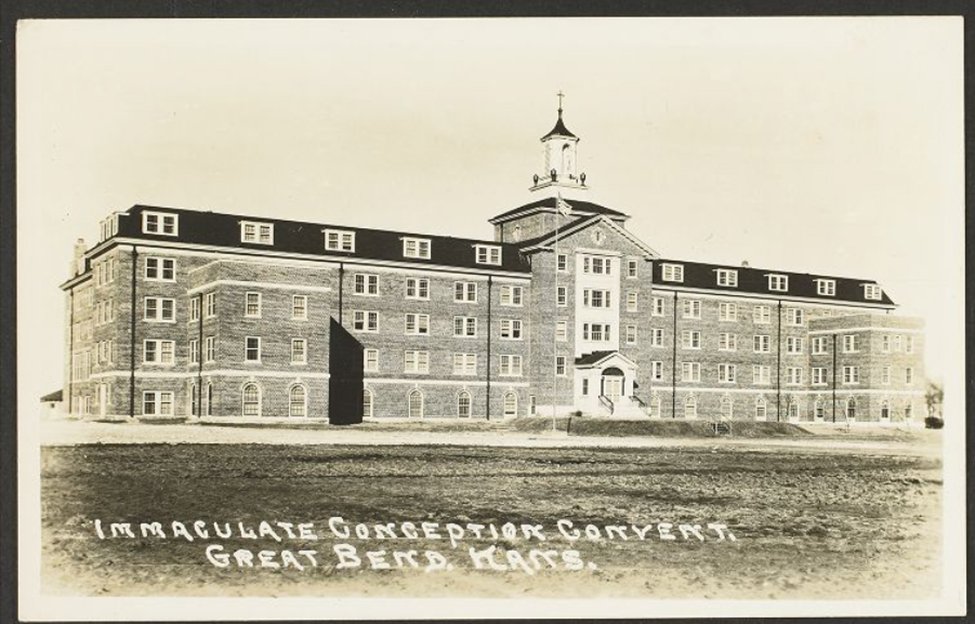
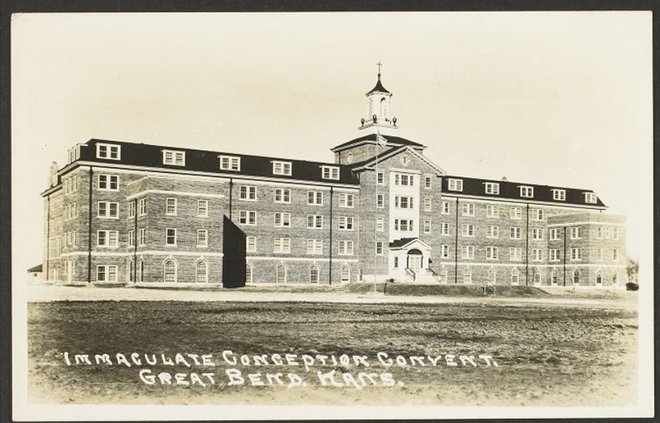
With the news of the closing of the Dominican Convent at 3600 Broadway, an era has come to an end. Since the opening of the Convent in 1902, they have had a quiet but influential presence in Central Kansas. Their vocation has extended far beyond the walls of convents and chapels. They have taught children in classrooms, mentored young adults, cared for the sick and elderly, comforted the dying, counseled families in times of crisis, and advocated for those on the margins of society.
For the Keenan family, the Convent and the nuns who dedicated their lives to the service of the Lord were a central part of our upbringing. For 50 years our home was across the street, to the north, on 17th Street. The Dominicans were our teachers at St. Patrick’s and when class wasn’t in session, we spent days exploring the vast territory of the Convent grounds.
Their property was a wide-open space, rich with grottos, reflecting pools, koi ponds, manicured flower gardens, and walkways that made for a perfect bike path on a crisp Saturday morning in May. It was also blessed with wide open spaces with freshly cut grass that formed the perfect venue for tackle football and endless other games that involved zero parent supervision. The thick row of evergreen trees along 17th Street was perfect cover for winter days to launch snowballs at cars driving by.
And as an additional measure, our dad, Larry served as their legal advisor whenever the Mother Superior needed legal advice from time to time.
Chapter One: The Early Years
August 29, 1960
It was a warm summer day in August 1960 when the family car, a Buick, pulled up to the Prep School building on the east side of the Dominican Sisters’ property at 3600 Broadway in Great Bend. The building was two stories. In the back seat was an anxious but also confident 15-year-old arriving from Schulte, Kan. Two hours earlier, all her possessions were placed in one small piece of luggage.
Her name was Janice Thome.
Her new home was a place where she did not know a single person. Yet that did not deter her. Though she arrived without a familiar face to greet her, she did not come alone. She carried with her a deep faith in God—a faith that gave her comfort, and confidence for the journey ahead.
She was enrolling as a sophomore at the Prep School. She was joining approximately 40 other students. The students wore a white blouse and a black skirt. During that time, students could have visitors once a month. Janice’s mother Grace was pregnant and could not travel. “My dad Fred sent a letter with my brother Dale who came with another family to visit me. In the letter he said that they felt that if I thought God was calling me, they would support my decision.”
This decision had its origin just a few years earlier, in events that Janice took as a sign.
“Several random incidents in 7-9th grades, initiated by others, brought the idea of a possible religious vocation to my attention. I decided that the best way to figure it out was to go to a special high school to explore it further,” Janice shared.
“After the first three weeks in Great Bend, I felt that God was really calling me. I wrote a letter to my parents to tell them that. They never told me until years later how difficult it was for them to let me leave home at such a young age.”
In year two, students entered the convent, as postulates and wore a black uniform with a veil that served as a head covering. The following June students took the habit – long flowing robe with head coverings – was worn all day. All it would show was her hands and face.
At that time, everyone took a name. Janice took the name of an aunt who had passed. Her name was Sister Leonita.
It would be another seven years before Final Vows. For Janice she would wait until she was 26.
Now, 65 years after her arrival on that August afternoon, Janice continues her ministry to thousands in Garden City. Over her years she taught at a number of schools in the area – St. Patrick’s in Great Bend, Trinity Junior High and High School in Hutchinson and at St. John’s in Hoisington.
We will return to Sister Janice in the next article. And, in particular, her years of teaching at St. Patrick’s, and in particular, her students in school year of 1970-1971.
The origins of the Dominican Order
The Communities of the Dominican Sisters dates back to Ratisbon – today it’s known as Regensburg - Germany, in 1233 AD. Regensburg, located on the Danube River in Southeast Germany, has a large Catholic population, significantly greater than the rest of the country. It is worth adding that Pope Benedict XVI was obviously German, and had a close connection to that city, and was a professor at a university there in the ’70s. He also had a brother who lived there.
Much of the early details of the formation of the Dominicans can be gleaned from a Master’s Thesis by Theodosia Tockert, Jr., herself a Dominican, at Fort Hays State, entitled: “The Community of the Dominican Sisters of Great Bend, Kansas, 1902-1941.” Her work, completed in 1945, describes the early history of the Dominicans in this way:
“The Dominican Order is a trinity of Orders. The First Order is made up of priests, students and lay brothers; the Second Order is made up of strictly cloistered nuns under solemn vows; the Third Order is twofold: (a) Conventual Sisters under simple vows, whether purely contemplative or active; (b) the Secular Third Order whether members of the clergy, or lay men and lay women.”
The Order left Germany when four sisters decided to come to Brooklyn in 1853.
Tockert’s thesis describes the beginning this way:
“It was not until July 25, 1853, that the four Sisters sailed for America and reached New York August 26, 1853. The foundation at Williamsburg is now officially known by the title The Sisters of the Third Order of St. Dominic of the American Congregation of the Holy Cross in the Diocese of Brooklyn.”
This move to America coincided with an enormous period of immigration from Germany. This was in the 1850s. There were three distinct faiths – Lutherans, Catholics and Mennonites. Lutherans made up about 55% of these populations, Catholics a third and Mennonites a much smaller percentage.
Many of the Catholic families settled in Kansas in the 1870-1880 period. Readers would know this very well – towns like Ellsworth, Great Bend, Hays, Victoria and Olmitz were settled in this time.
Dominicans come to Great Bend
No person is more responsible for the Dominicans coming to Barton County than a priest named Father Walter Emmerich. Emmerich was a German immigrant who came to the U.S. in 1871 and was ordained on May 19, 1891. At that time, there was no Dodge City diocese, and so Emmerich’s service started at Newton but then took him to Odin. In 1896 he was transferred to Ellinwood. He was responsible for building the limestone church there, St Josephs. Ellinwood was his longest assignment.
Father Emmerich had a sister in the Dominican order in Brooklyn. Her name was Sister Borromea. Through Sister Borromea, the Mother Superior in Brooklyn, Mother Seraphine, approached Father Emmerich about establishing a beachhead in Kansas. The concept was to offer a place for rest and recuperation for the nuns who were ailing in Brooklyn.
These discussions started in 1888. But the essential contact in Brooklyn was Sister Antonina.
Mother Superior Antonina Fischer, the Convent Foundress
Born in Bavaria and brought to the United States in 1852 by her parents, she was the leader in opening the mother house in Great Bend. Tockert’s work includes correspondence between Sister Antonina and Emmerich and those letters were written in German.
On Nov. 30, 1901, the move was approved by the Dominican authorities in Brooklyn.
On April 16, 1902 Sister Antonina and six of her fellow sisters left Brooklyn. They arrived in Great Bend on April 23.
Tockert’s treatise describes their arrival this way: “When Mother Antonina and her courageous companions stepped off the train in Great Bend, Kansas, April 23, 1902, at 7:20 p.m., they expected to be conducted to their future home, when they learned that they were shelterless. Reverend Wiersma, then pastor of Great Bend, greeted them thus: ‘I’m sorry to say, but you have no home, your house is still occupied by the students of the college.’ How this incident happened no one seems to know; the fact remained that no provision had been made to receive the Nuns, and they found themselves on that April night, homeless, and alone.”
They found a way.
Cars were rare in Great Bend in this time period, and for transportation they had the benefit of two horses.
When they arrived, this was a photograph taken.
Focus on education and health care
The Dominicans opened their first school later that year, and established a small eight bed hospital in 1903. The high school opened in 1917. It was fully accredited in 1914.
In 1918 they changed the name from “St. Mary’s Convent” to “Immaculate Conception Convent.” By 1928, the sisters were responsible for teaching at 11 parochial schools in the diocese of Wichita – which included all of Central Kansas. The Dodge City diocese was not separately formed until May, 1951.
Education was an essential part of their mission. The popularity of Catholic schools had its genesis in a variety of forces at play at the turn of the Century. In the early 1920’s there was considerable anti-Catholic bias sweeping the country. It took many forms including a presence of the Ku Klux Klan. The Klan was most active in Southeast Kansas but had a presence in Reno County.
Some states sought to ban Catholic schools completely. The state of Oregon, for example, passed a law that required all public-school education for children. Called the Compulsory Education Act, it required nearly all children between ages 8 and 16 to attend public schools.
In 1925 it was challenged and the case went to the United States Supreme Court. The case was Pierce v. Society of Sisters and a unanimous Supreme Court struck down Oregon’s compulsory public-school law.
Private schools had a rebirth.
At one time, the Dominicans were responsible for 16 grade schools, and two accredited high schools. From 1902 to present – the schools included the following:
Ellinwood (St. Joseph) (St. Peter and Paul); Hutchinson (St. Theresa’s); Odin (Holy Family); St. Leo (St. Leo); Beaver (St. Joseph); Schulte (St. Joseph); Fowler (St. Anthony); Liebenthal (St. Joseph); Sharon (St. Boniface); Seward (St. Francis); Larned (Sacred Heart); Great Bend (St. Rose, St. Patrick); Garden City (St. Mary).
Coming next: Life at St. Patrick’s and St. Rose
Of all the schools the Dominicans operated, two were most prominent in the lives of those of us in Great Bend – St. Rose and St. Patrick’s. The next article will describe life at these schools in the 1960s. Through the eyes of the students who attended there and the teachers who taught them.